

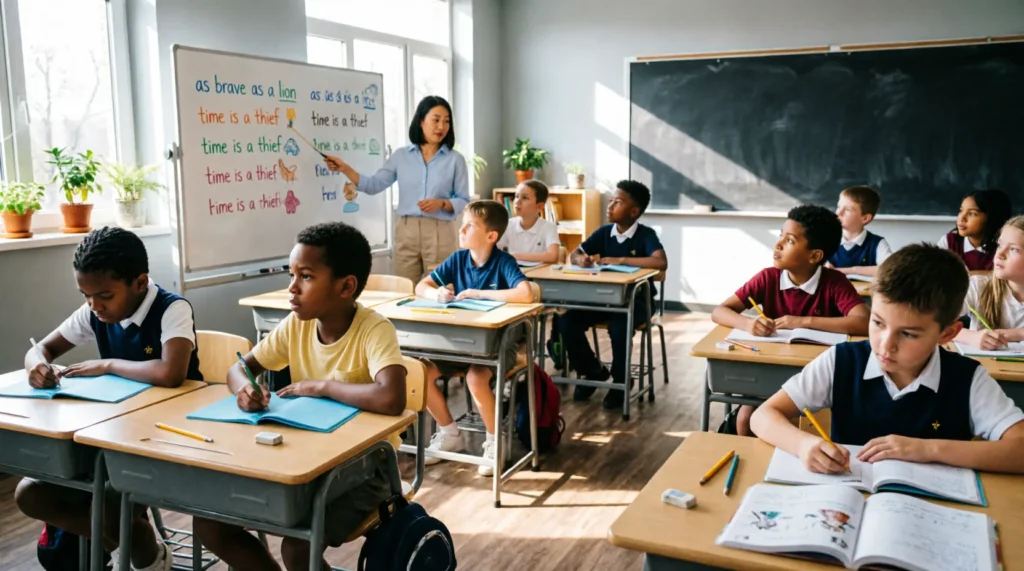
Learning Objectives for Similes and Metaphors: A Complete Guide for Teachers
When students master similes and metaphors, they unlock a powerful way to make their writing vivid and memorable. This guide breaks down clear learning objectives for similes and metaphors that help educators structure effective lessons from basic recognition through sophisticated creative application. Below you’ll find categorized examples organized by skill level, each demonstrated in context so you can see exactly how these comparisons function in real writing.
What Is a Simile?
A simile is a figure of speech that directly compares two different things using “like” or “as” to highlight a shared quality. It’s one of the most accessible forms of figurative language because the comparison is explicit—the writer tells you exactly what they’re comparing. For instance, saying “her smile was like sunshine” creates an immediate sensory connection between warmth, brightness, and happiness.
The key difference between a simile and a metaphor is that a metaphor makes a direct identification without using “like” or “as”—it states that one thing is another thing. Where a simile says “he runs like the wind,” a metaphor would say “he is the wind.” understanding this distinction forms the foundation of all subsequent work with comparative language.
Foundational Recognition: Basic Similes for Identifying the Pattern
When I introduce similes to students, I start with crystal-clear examples that make the “like” or “as” structure impossible to miss. These straightforward comparisons help learners recognize the pattern before moving to more nuanced examples. The goal here is building confidence through recognition.
-
“as busy as a bee” — “My mom was as busy as a bee all morning, cleaning, cooking, and organizing.” (lighthearted, familiar)
-
“like a bolt of lightning” — “The idea hit me like a bolt of lightning during my shower.” (sudden, energetic)
-
“as cold as ice” — “His rejection was as cold as ice, leaving me stunned.” (harsh, unfriendly)
-
“like two peas in a pod” — “The twins dressed alike and finished each other’s sentences, like two peas in a pod.” (affectionate, emphasizing similarity)
-
“as light as a feather” — “The fabric was as light as a feather, perfect for summer dresses.” (delicate, airy)
-
“like a fish out of water” — “At the fancy gala, I felt like a fish out of water in my casual clothes.” (uncomfortable, out of place)
-
“as quick as a flash” — “She answered the question as quick as a flash, having studied all night.” (impressive speed)
-
“like watching paint dry” — “The lecture was like watching paint dry—endless and painfully slow.” (boring, tedious)
These examples work because they’re instantly recognizable. The version my students always reach for first is “as busy as a bee”—it’s almost muscle memory at this point. However, I’ll be honest: several of these are worn clichés. “Cold as ice” and “light as a feather” have been used so often they’ve lost their punch. I encourage students to recognize them as learning tools, then push beyond them to create fresher comparisons.
Sensory Development: Similes That Engage the Five Senses
Once students can identify basic similes, the next learning objective is helping them create comparisons that activate sensory experience. Strong writing doesn’t just tell readers what something is like—it makes them feel, hear, smell, taste, or see it. These similes demonstrate how figurative language can transport readers into a moment.
-
“like velvet against skin” — “The peach was ripe and soft, like velvet against skin.” (tactile, luxurious)
-
“like thunder rolling through the room” — “His laughter was like thunder rolling through the room, impossible to ignore.” (auditory, powerful)
-
“as bright as a thousand suns” — “The explosion lit the night sky as bright as a thousand suns.” (visual, overwhelming)
-
“like burnt toast” — “The smell of the kitchen fire was like burnt toast, sharp and acrid.” (olfactory, unpleasant)
-
“like honey on the tongue” — “Her voice was smooth like honey on the tongue, soothing and sweet.” (taste/sound synesthesia, pleasing)
-
“as sharp as shattered glass” — “His criticism was as sharp as shattered glass, cutting deep.” (tactile/emotional, painful)
-
“like a symphony of chaos” — “The marketplace was like a symphony of chaos, with vendors shouting and music blaring.” (auditory, overwhelming but rhythmic)
-
“as warm as fresh-baked bread” — “Her hug was as warm as fresh-baked bread, comforting and familiar.” (tactile/emotional, nurturing)
The reason “like velvet against skin” works so well is that it combines texture with an implicit temperature and quality of movement—it’s not just soft, it’s luxuriously, deliberately soft. That’s the kind of multi-layered comparison I push students toward once they’ve mastered the basics.
Emotional Expression: Similes for Conveying Feelings
One of the most important learning objectives for similes and metaphors is helping students articulate complex emotions. Feelings are abstract and internal; similes give them concrete form that readers can understand. this moves students from simple identification to sophisticated application of figurative language for specific communicative purposes.
-
“like a weight lifted from my shoulders” — “When she apologized, it was like a weight lifted from my shoulders.” (relief, release) For more, see Similes and Metaphors: Comparisons Done Right.
-
“as if my heart had been wrung out like a wet rag” — “After the breakup, I felt as if my heart had been wrung out like a wet rag.” (exhaustion, devastation)
-
“like butterflies doing gymnastics” — “Before my presentation, I had butterflies doing gymnastics in my stomach.” (nervous excitement, updated cliché)
-
“as hollow as an abandoned house” — “His apology rang hollow, as hollow as an abandoned house.” (emptiness, insincerity)
-
“like sunlight breaking through storm clouds” — “Her smile was like sunlight breaking through storm clouds after weeks of rain.” (hope, relief, visual beauty)
-
“as tangled as old headphones” — “My thoughts were as tangled as old headphones pulled from a pocket.” (confusion, frustration, modern relatable)
-
“like standing on the edge of a cliff” — “Starting my new job felt like standing on the edge of a cliff, terrifying and exhilarating.” (anxiety mixed with anticipation)
-
“as steady as an anchor in a storm” — “My best friend was as steady as an anchor in a storm during my crisis.” (reliability, strength, maritime imagery)
I’m particularly fond of “as tangled as old headphones” because it takes a universal modern frustration and applies it to an internal state. It’s specific enough to be vivid but universal enough that anyone who’s ever dealt with knotted earbuds immediately understands the feeling. This is the kind of contemporary, relatable comparison that makes figurative language feel alive rather than archaic.
Action and Movement: Dynamic Similes for Energetic Writing
Static descriptions have their place, but powerful writing often needs to capture motion, energy, and change. These similes help students describe action in ways that convey not just what happened, but how it happened—the quality, speed, and character of movement.
-
“like a rocket taking off” — “When the bell rang, the kids shot out of the classroom like a rocket taking off.” (explosive speed, upward energy)
-
“as graceful as a swan” — “The dancer moved across the stage as graceful as a swan gliding on water.” (elegance, fluidity)
-
“like a deer in headlights” — “When the teacher called on him, he froze like a deer in headlights.” (paralyzed fear, sudden stillness)
-
“as relentless as ocean waves” — “The paparazzi pursued the celebrity as relentless as ocean waves crashing against the shore.” (persistent, unstoppable force)
-
“like a cat stalking a mouse” — “The detective followed the suspect like a cat stalking a mouse, patient and silent.” (predatory focus, controlled movement)
-
“as chaotic as a beehive kicked over” — “The evacuation was as chaotic as a beehive kicked over, with people running in every direction.” (panicked, disorganized energy)
-
“like a pendulum swinging” — “His mood shifted like a pendulum swinging, from joy to despair and back again.” (rhythmic, predictable oscillation)
-
“as smooth as butter” — “The negotiation went as smooth as butter, with both sides reaching agreement quickly.” (effortless, frictionless)
The craft note on “like a rocket taking off”: this simile works because it combines vertical movement with acceleration and a sense of inevitable momentum. You can’t stop a rocket once it’s launched—that’s the quality being transferred to the students’ movement. It’s more specific than just saying “fast.”
Advanced Metaphorical Thinking: Direct Comparisons Without “Like” or “As”
Once students have mastered similes, the next learning objective is helping them understand and create metaphors—the more advanced sibling of simile. Metaphors require a deeper conceptual leap because they assert identity rather than comparison. This is where figurative language becomes truly transformative.
-
“Time is a thief” — “Time is a thief, stealing moments we’ll never get back.” (poignant, universal truth about mortality)
-
“Her voice was music to his ears” — “When she said yes, her voice was music to his ears.” (pleasure, harmony, emotional resonance) For more, see Objectives.
-
“The classroom was a zoo” — “During free period, the classroom was a zoo, with students climbing on desks and shouting.” (chaos, wildness, loss of control)
-
“He’s a night owl” — “My brother is a night owl, most creative and alert after midnight.” (natural rhythm, creature of darkness)
-
“Life is a rollercoaster” — “Life is a rollercoaster, full of unexpected drops and thrilling climbs.” (unpredictability, emotional highs and lows)
-
“The world is a stage” — “The world is a stage, and we’re all just playing our parts.” (theatrical, philosophical perspective on human behavior)
-
“Her memory is a steel trap” — “My grandmother’s memory is a steel trap—she remembers everything from fifty years ago.” (strength, precision, unyielding retention)
-
“The news was a punch to the gut” — “The layoff announcement was a punch to the gut, leaving me breathless.” (sudden physical impact, visceral shock)
I want to flag “Life is a rollercoaster” as overused—it’s become such a cliché that it rarely surprises readers anymore. However, it remains useful for teaching because it clearly demonstrates how metaphor works: life doesn’t literally become a rollercoaster, but the comparison highlights shared qualities of unpredictability and emotional intensity. Once students understand the mechanism, I push them to find fresher vehicles for the same concept.
How to Write Your Own Simile: A Simple Three-Step Process
Creating original similes becomes much easier when you break it down into manageable steps. Here’s the method I teach in workshops:
Step 1: Identify the quality you want to emphasize. What aspect of your subject matters most? Is it speed, texture, emotional impact, color, sound? Be specific. Instead of “she was sad,” think “her sadness felt heavy and inescapable.”
Step 2: Brainstorm concrete things that share that quality. If you’re describing heaviness, what feels heavy? Wet wool, an anchor, a stone, a soaked blanket, a backpack full of books. Don’t censor yourself—list everything that comes to mind.
Step 3: Choose the comparison that creates the strongest image or feeling. Test each option by saying it aloud. Does it feel fresh? Does it add information beyond the obvious? Does it fit the tone of your piece?
Worked example: Let’s say you’re describing anxiety before a job interview.
- Quality: jittery, uncontrollable energy
- Brainstorm: popcorn popping, a trapped bird, a shaken soda can, a hummingbird’s wings, static electricity
- Best choice: “My nerves were like a shaken soda can, fizzing and ready to explode at the slightest disturbance.”
This works because it suggests both the internal pressure and the fear of losing control—more nuanced than just saying “I was nervous.”
Frequently Asked Questions
What are the key learning objectives for teaching similes and metaphors?
The progression typically moves from recognition (identifying similes and metaphors in text) to comprehension (understanding what the comparison means) to application (creating original comparisons) and finally to analysis (evaluating the effectiveness of different figurative choices). Students should be able to distinguish between similes and metaphors, explain what quality is being compared, and eventually craft their own vivid comparisons.
At what grade level should students learn similes and metaphors?
Basic recognition of similes typically begins in late elementary school (grades 3-5), when students can identify the “like” or “as” pattern. Metaphors usually follow in middle school (grades 6-8) as students develop more abstract thinking skills. However, sophisticated creation and analysis of figurative language continues through high school and beyond, with increasing complexity in the types of comparisons students are expected to understand and produce.
How do I help students avoid clichéd similes and metaphors?
The best strategy is awareness followed by revision. Have students identify common clichés (“busy as a bee,” “cold as ice,” “light as a feather”) and discuss why they’ve lost impact through overuse. Then challenge them to create fresher alternatives by choosing more specific or unexpected comparison points. Instead of “brave as a lion,” maybe “brave as a lighthouse keeper in a hurricane”—it’s still about courage, but with a more specific, visual scenario.
What’s the difference between a simile, metaphor, and analogy?
A simile compares two things using “like” or “as” (“her eyes sparkled like diamonds”). A metaphor states that one thing is another (“her eyes were diamonds”). An analogy is more extended and explanatory—it compares two things to clarify a complex idea, often running several sentences or even paragraphs. Similes and metaphors are typically brief and decorative; analogies are functional tools for explanation and argument.

Richard Jackson is an expert in semantics and figurative language, with particular expertise in simile theory and practice. Holding a Ph.D. in Linguistics from Harvard University, where his thesis focused on simile and metaphor in modern literature, Richard has dedicated over 20 years to the study of figurative language. His journey into this field began with a fascination for how similes can unlock deeper meanings and create resonant storytelling moments. Richard’s work examines the cognitive processes behind simile construction and comprehension, offering insights into how these figures of speech influence reader perception. He has published numerous articles and book chapters, cementing his status as a thought leader in the linguistic community. At SimileStation, Richard writes about the psychological underpinnings of similes, comparative linguistic analyses, and offers tips for writers aiming to enhance their craft. His dedication to language is as deep as the ocean, continually exploring new depths in the world of figurative expression.