

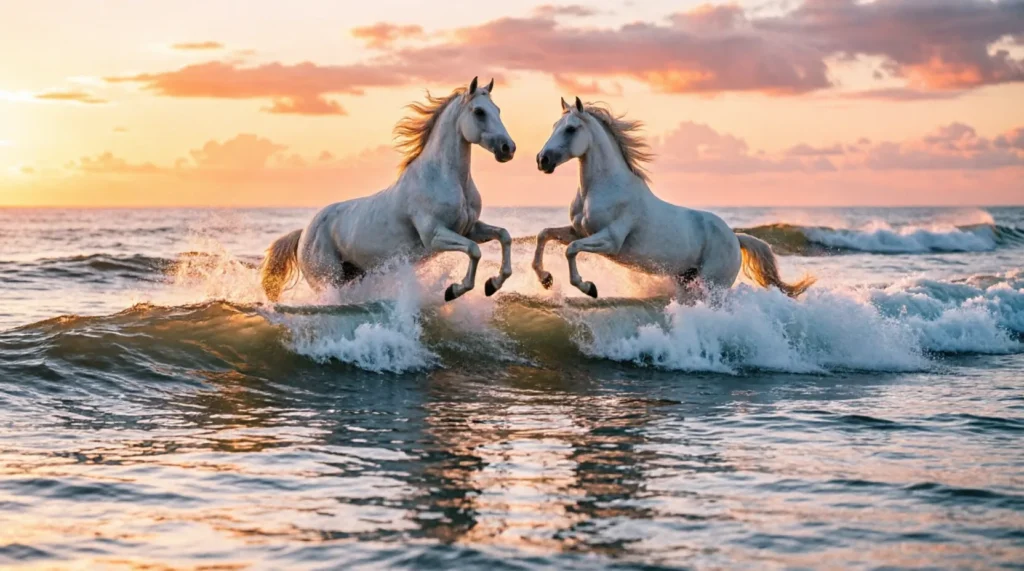
The ocean has inspired poets, novelists, and songwriters for centuries because it resists simple description. Whether you’re drafting a college admissions essay about a transformative voyage or writing a eulogy that compares grief to tidal forces, having a robust collection of ocean comparisons at your fingertips transforms vague imagery into visceral experience. The similes and metaphors below are organized by mood and intensity so you can find exactly the comparison your piece demands.
Turbulent and Threatening Waters
When the ocean turns hostile, it becomes a force that dwarfs human concerns. These comparisons work best in scenes of conflict, danger, or overwhelming emotion.
- “The sea roared like a wounded beast” — “As the storm approached, the sea roared like a wounded beast, churning white foam against the black rocks.” (menacing, primal)
- “Waves crashed like thunder” — “The waves crashed like thunder against the hull, each impact shaking the timbers.” (violent, deafening)
- “The ocean was a hungry mouth” — “In the darkness, the ocean was a hungry mouth waiting to swallow the tiny skiff whole.” (predatory, ominous)
- “Raging like a tempest” — “Her anger was raging like a tempest, impossible to calm or reason with.” (uncontrollable, fierce)
- “The sea churned like a boiling cauldron” — “Beneath the hurricane’s eye, the sea churned like a boiling cauldron, spitting spray hundreds of feet into the air.” (chaotic, dangerous)
- “Waves rose like walls” — “The waves rose like walls before the surfers, daring them to attempt the impossible.” (intimidating, monumental)
- “The ocean snapped like a whip” — “When the wind shifted, the ocean snapped like a whip, turning from glass to fury in seconds.” (sudden, violent)
The “hungry mouth” metaphor is one I return to repeatedly because it activates multiple senses at once—you can almost feel the suction, hear the gulp, sense the inevitability. According to Wikipedia’s entry on Metaphor, the most powerful metaphors create what scholars call “conceptual blending,” merging two distinct ideas into something greater than either alone.
Avoid “angry ocean” or “furious sea”—these are tired shortcuts that tell rather than show. Your readers have encountered storms before; give them something that makes them feel the salt spray on their own faces.
Calm and Serene Seas
Not every ocean moment demands drama. Sometimes you need language that captures stillness, peace, or meditative quiet.
- “The water lay like polished glass” — “At dawn, the water lay like polished glass, reflecting the pink sky without a single ripple.” (tranquil, pristine)
- “Smooth as silk” — “The bay was smooth as silk, perfect for the beginner kayakers.” (gentle, inviting)
- “The ocean breathed like a sleeping giant” — “In the lull between storms, the ocean breathed like a sleeping giant, rising and falling with slow, rhythmic certainty.” (peaceful, powerful)
- “Calm as a millpond” — “The harbor was calm as a millpond, the boats bobbing gently at their moorings.” (still, safe)
- “The sea whispered like a lullaby” — “Against the shore, the sea whispered like a lullaby, soft enough to coax the children to sleep.” (soothing, tender)
- “Flat as a mirror” — “The lagoon was flat as a mirror, doubling the coconut palms in perfect reflection.” (serene, symmetrical)
- “Gentle as a mother’s hand” — “The tide came in gentle as a mother’s hand, barely disturbing the sandcastles.” (nurturing, delicate)
The “sleeping giant” comparison earns its place because it holds tension within tranquility—you sense the power even in the peace. This is the version my students always reach for first when describing a calm that feels temporary or fragile.
Skip “pretty ocean” or “nice water.” These descriptors are so vague they could apply to a puddle or a swimming pool. Specificity is your lifeline.
Mysterious and Unfathomable Depths
The ocean’s greatest power lies in what we cannot see. These comparisons evoke the unknown, the hidden, the unknowable.
- “Deep as eternity” — “His eyes were deep as eternity, holding secrets he would never share.” (profound, timeless)
- “The ocean was a locked vault” — “Beneath the surface, the ocean was a locked vault holding treasures no diver had ever found.” (secretive, valuable)
- “Dark as forgotten memories” — “The trench was dark as forgotten memories, lightless and cold.” (obscure, melancholic)
- “The sea kept its counsel like an old wizard” — “Through centuries of ships and storms, the sea kept its counsel like an old wizard, revealing nothing to those who asked.” (wise, inscrutable)
- “Mysterious as a riddle” — “The creature’s migration pattern remained mysterious as a riddle, defying every explanation marine biologists proposed.” (puzzling, elusive)
- “The depths were a silent library” — “In the midnight zone, the depths were a silent library where ancient creatures moved between shelves of coral.” (scholarly, ancient)
When I workshop student writing, I push them toward the “silent library” metaphor because it transforms emptiness into abundance—the ocean isn’t empty; it’s full of stories we haven’t learned to read yet.
According to Wikipedia’s article on Simile, effective similes use “like” or “as” to create explicit comparisons that help readers understand unfamiliar concepts through familiar ones. The “locked vault” works because everyone understands both the frustration and the allure of something valuable just out of reach.
Avoid “mysterious deep” as a standalone phrase—it’s become such a cliché in adventure novels that it triggers eye-rolls rather than wonder.
Restless and Ever-Moving Waters
The ocean never truly stops. These comparisons capture motion, persistence, and relentless energy.
- “The tide pulled like an insistent hand” — “Even as she tried to walk away, the tide pulled like an insistent hand, tugging at her ankles.” (persistent, compelling)
- “Waves rolled like endless breaths” — “From the cliff, the waves rolled like endless breaths, the ocean’s chest rising and falling without pause.” (rhythmic, eternal)
- “The current ran like blood through veins” — “Through the reef channels, the current ran like blood through veins, carrying life to every corner.” (vital, organic)
- “Restless as a caged animal” — “In the narrow strait, the water was restless as a caged animal, surging against the rocks.” (frustrated, energetic)
- “The sea never slept” — “While the village dozed, the sea never slept, polishing stones and reshaping the coastline grain by grain.” (tireless, patient)
- “Waves chased each other like children” — “On the gentle beach, waves chased each other like children, laughing as they tumbled onto the sand.” (playful, joyful)
- “The ocean paced like a sentry” — “Along the rocky shore, the ocean paced like a sentry, guarding secrets it had held for millennia.” (vigilant, protective)
The “endless breaths” comparison is particularly effective because it connects the ocean’s movement to something fundamentally human—we all understand breathing, making the vast sea feel intimate and relatable.
Don’t use “moving water” or “flowing sea.” These are redundant descriptions that add nothing. Every body of water moves; what matters is how it moves and what that movement suggests.
Vast and Overwhelming Scale
Sometimes you need to convey immensity, the way the ocean makes human concerns feel small.
- “Wide as forever” — “From the deck, the horizon stretched wide as forever, no land in any direction.” (infinite, isolating)
- “The ocean was an endless page” — “To the writer, the ocean was an endless page waiting for words that might never come.” (blank, intimidating)
- “Vast as the sky” — “The lagoon was vast as the sky, water and air meeting in a line so distant it might have been imaginary.” (expansive, boundless)
- “The sea swallowed the horizon” — “In the fog, the sea swallowed the horizon, leaving the ship suspended in gray nothingness.” (consuming, disorienting)
- “Endless as time” — “The beach curved endless as time, each grain of sand a second that had already passed.” (temporal, philosophical)
- “The ocean dwarfed the mountains” — “From the air, the ocean dwarfed the mountains, reducing ancient peaks to mere wrinkles on water’s surface.” (humbling, monumental)
I tell my students that “wide as forever” works because it collapses spatial and temporal distance into a single image—you’re not just describing size, you’re describing the emotional experience of size.
Avoid “really big ocean” or “huge sea.” These are the linguistic equivalent of shrugging. If you can’t find a comparison that makes your reader feel small, keep searching.
Luminous and Changing Light
The ocean’s relationship with light creates some of writing’s most gorgeous opportunities.
- “The water sparkled like scattered diamonds” — “At noon, the water sparkled like scattered diamonds, too bright to look at directly.” (brilliant, dazzling)
- “Blue as a sapphire” — “The tropical bay was blue as a sapphire, a color so intense it seemed artificial.” (precious, vivid)
- “The sea glowed like molten copper” — “At sunset, the sea glowed like molten copper, liquid fire stretching to the horizon.” (warm, transformative)
- “Shimmering like heat haze” — “On the distant reef, the water was shimmering like heat haze, distorting everything beneath.” (ethereal, elusive)
- “The ocean wore moonlight like jewelry” — “At midnight, the ocean wore moonlight like jewelry, each wave a necklace of silver.” (elegant, adorned)
- “Green as jade” — “In the shallows, the water was green as jade, translucent and cool.” (gem-like, refreshing)
- “The sea caught fire with dawn” — “Before the sun broke the horizon, the sea caught fire with dawn, burning orange and pink.” (dramatic, radiant)
The “molten copper” metaphor is one I defend fiercely because it captures both color and texture—the ocean isn’t just reflecting sunset; it’s become something new, something dangerous and beautiful.
Skip “pretty blue water” or “sparkly ocean.” These are greeting-card descriptions that belong on mass-produced calendars, not in serious writing.
How to Write Your Own Ocean Simile
Creating original ocean comparisons isn’t as mysterious as the subject itself. Follow this simple process:
Step 1: Identify the specific quality you want to emphasize. Is it the ocean’s power, its stillness, its color, its sound, its temperature? Don’t try to capture everything at once.
Step 2: Brainstorm objects, creatures, or phenomena that share that quality. If you’re describing the ocean’s persistence, think of things that never stop: a heartbeat, a clock, erosion, aging.
Step 3: Test your comparison by asking: Does this create a clear image? Does it evoke emotion? Would a reader understand it immediately, or does it require too much explanation?
Worked Example: Let’s say you’re writing about the ocean’s ability to erase痕迹 (traces). You might start with: “The tide removes footprints.” That’s accurate but flat. What else removes痕迹? A eraser, time, forgiveness, sleep. “The tide erased our footprints like time erases memory.” Now you have something that works on multiple levels—the physical action mirrors an emotional truth.
Frequently Asked Questions
What’s the difference between a simile and a metaphor for the ocean?
A simile uses “like” or “as” to make a comparison explicit (“the ocean was like glass”), while a metaphor states the comparison as fact (“the ocean was glass”). Similes tend to feel more tentative and poetic; metaphors feel more confident and immediate. Both have their place depending on the tone you’re after.
Which ocean similes are too clichéd to use?
Steer clear of “deep as the ocean,” “sea of tears,” “ocean of love,” and “angry seas.” These have been used so frequently they’ve lost their impact. Your goal is to surprise your reader, not confirm their expectations. If you’ve heard a comparison in a pop song or Hallmark card, it’s probably time to invent something new.
Can I mix ocean metaphors with other natural imagery?
Absolutely. Some of the most powerful writing connects the ocean to mountains, forests, or weather systems. “The waves climbed like mountains” or “the current flowed like wind through trees” creates layered imagery that enriches rather than confuses. Just ensure your comparisons work together rather than fighting for attention.
How do I choose between a calm ocean metaphor and a stormy one?
Let your context decide. A eulogy might benefit from the ocean’s eternal, unchanging qualities. A thriller demands the ocean’s dangerous, unpredictable nature. A romance could use either—the gentle caress of waves or the overwhelming force of a tsunami—depending on whether you’re describing comfort or passion. Match the ocean’s mood to your scene’s emotional temperature.

Kenneth White is a seasoned linguist with over 15 years of experience in studying and teaching figurative language. He earned his Master’s degree in English Literature from Yale University, where he developed a deep interest in the art of similes and metaphors. His fascination with how similes enhance storytelling and evoke vivid imagery has been a guiding force throughout his career. Kenneth has conducted numerous workshops and seminars, educating students and fellow writers on effectively incorporating similes into their work. He has authored several papers detailing the evolution of simile usage across different literary periods. At SimileStation, Kenneth focuses on exploring the historical significance of similes and how they reflect cultural contexts. His articles dissect famous literary works, highlighting the creative use of figurative language to inspire emerging writers. Kenneth’s passion for language is as unwavering as a lighthouse in a storm, guiding readers through the complexities of simile construction and application.