

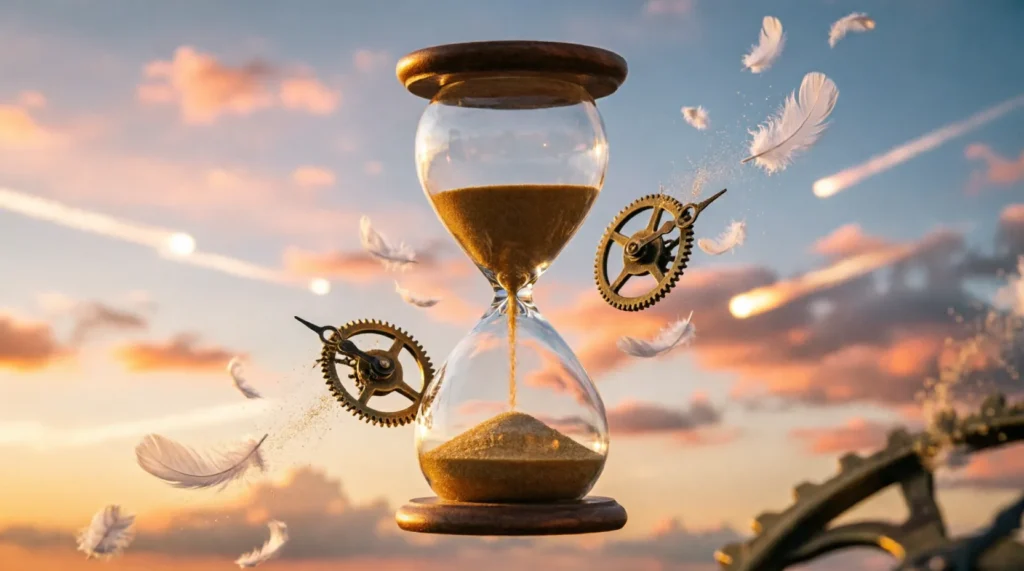
Similes and metaphors for time flying by help writers convey the disorienting speed of life without resorting to clichés. The examples below are categorized by emotion and context, giving you ready-to-use phrases that feel fresh rather than recycled. Use them to anchor abstract feelings in concrete imagery your readers can see and feel.
What Is a Simile?
A simile is a figure of speech that directly compares two different things using “like” or “as.” It creates a vivid connection between an abstract concept—such as the passage of time—and a tangible image, making the feeling more immediate for the reader. According to Metaphor, while metaphors state that one thing is another, similes maintain the distinction by saying one thing is like another, which often feels less aggressive and more observational. This subtle difference makes similes particularly effective when describing fleeting moments, as they invite the reader to participate in the comparison rather than forcing a conclusion.
Nostalgic and Bittersweet
These similes capture the ache of looking back. They work best in memoirs, eulogies, or reflective essays where the tone is gentle but tinged with regret.
- “like sand slipping through fingers” — “The summer ended like sand slipping through fingers, no matter how tightly I tried to hold on.” (helpless, granular)
- Craft note: This works because it engages the tactile sense. Everyone knows the frustration of trying to grip something fine and dry; it mirrors the futility of stopping time.
- “as fleeting as a breath on glass” — “Her childhood was as fleeting as a breath on glass, visible for a second before vanishing into the air.” (fragile, temporary)
- “like a dream upon waking” — “The vacation felt like a dream upon waking, detailed yet already dissolving at the edges.” (disorienting, soft)
- “as quick as a shadow at noon” — “His youth passed as quick as a shadow at noon, barely there before it shifted.” (inevitable, natural)
- “like pages turning in a wind” — “The years went by like pages turning in a wind, chaotic and out of my control.” (uncontrolled, rapid)
- “as brief as a spark in the dark” — “Their reunion was as brief as a spark in the dark, bright but instantly gone.” (intense, short-lived)
- “like mist burning off morning grass” — “My anxiety lifted like mist burning off morning grass, slow at first then suddenly gone.” (gradual, natural)
- Craft note: Avoid this if you want urgency; it implies a slower, more natural dissolution rather than a sudden shock.
- “as transient as a rainbow” — “The peace we felt was as transient as a rainbow, beautiful but dependent on specific conditions.” (conditional, rare)
Chaotic and Overwhelming
Use these when time feels like it is attacking you. These are ideal for scenes involving deadlines, panic, or modern burnout.
- “like a runaway train” — “The week moved like a runaway train, loud and impossible to stop.” (dangerous, loud)
- “as frantic as bees in a jar” — “My schedule was as frantic as bees in a jar, buzzing with no clear exit.” (claustrophobic, noisy)
- “like water down a drain” — “My savings disappeared like water down a drain, swirling away faster than I could react.” (wasteful, irreversible)
- “as relentless as a ticking bomb” — “The deadline approached as relentless as a ticking bomb, each second adding pressure.” (threatening, precise)
- “like a carousel spinning too fast” — “Life felt like a carousel spinning too fast, the colors blurring into one nauseating streak.” (dizzying, repetitive)
- “as chaotic as static on a screen” — “The afternoon dissolved as chaotic as static on a screen, no clear signal remaining.” (confusing, white noise)
- “like leaves in a hurricane” — “Our plans scattered like leaves in a hurricane, directionless and torn.” (violent, scattered)
- Craft note: This is stronger than “leaves in the wind” because it adds violence. Use it only when the situation is truly out of control.
- “as dizzying as a rollercoaster drop” — “The news hit as dizzying as a rollercoaster drop, stomach in throat and world upside down.” (physical, shocking)
Natural and Elemental
These similes ground the passage of time in the physical world. They are excellent for literary fiction or nature writing where the human experience is tied to the environment.
- “like seasons changing” — “Her grief evolved like seasons changing, from the sharp cold of winter to the muddy thaw of spring.” (cyclical, inevitable)
- “as steady as a river current” — “Time moved as steady as a river current, pulling us forward whether we swam or floated.” (powerful, indifferent)
- “like clouds drifting across the sky” — “The arguments faded like clouds drifting across the sky, reshaping constantly until they were unrecognizable.” (slow, shape-shifting)
- “as inevitable as the tide” — “Change came as inevitable as the tide, rising regardless of our preparations.” (predictable, forceful)
- “like snow melting in palm” — “The opportunity vanished like snow melting in palm, cold and wet and suddenly empty.” (tactile, loss)
- “as quiet as falling snow” — “The year ended as quiet as falling snow, accumulating weight without making a sound.” (silent, heavy)
- “like erosion on a cliffside” — “His memory suffered like erosion on a cliffside, losing pieces gradually until the structure collapsed.” (destructive, slow)
- Craft note: This is a powerful metaphor for aging or dementia. It avoids the cliché of “fading away” by introducing physical degradation.
- “as swift as a hawk’s dive” — “The decision was made as swift as a hawk’s dive, precise and final.” (predatory, accurate)
Modern and Mechanical
These similes reflect our digital age. They work well in contemporary fiction, tech journalism, or essays about modern life.
- “like a buffering video” — “The conversation stalled like a buffering video, freezing at the most critical moment.” (frustrating, disjointed)
- “as fast as a fiber-optic pulse” — “News traveled as fast as a fiber-optic pulse, reaching the other side of the world before I could blink.” (instant, invisible)
- “like a skipped record” — “We repeated the same argument like a skipped record, stuck in the same groove.” (repetitive, annoying)
- “as automated as a factory line” — “My days passed as automated as a factory line, identical products rolling out without variation.” (monotonous, industrial)
- “like a glitch in the system” — “The hour disappeared like a glitch in the system, missing from the log entirely.” (error, confusing)
- “as disposable as a single-use plastic” — “Moments felt as disposable as a single-use plastic, used once and discarded without thought.” (wasteful, cheap)
- “like a loading screen” — “Waiting for the results felt like a loading screen, endless and devoid of content.” (empty, anticipatory)
- Craft note: This resonates with younger audiences who understand the specific anxiety of digital waiting. It turns a technical annoyance into an emotional state.
- “as fragmented as a broken pixel” — “His attention span was as fragmented as a broken pixel, unable to form a complete image.” (digital, incomplete)
Poetic and Abstract
These are for when literal comparisons fail. They suit poetry, lyrical prose, or moments of high emotion where logic takes a backseat to feeling.
- “like a echo in a canyon” — “His words lingered like a echo in a canyon, bouncing back long after he had stopped speaking.” (resonant, distant)
- “as thin as cigarette paper” — “The truth was as thin as cigarette paper, transparent and easily burned.” (fragile, dangerous)
- “like a ghost in the hallway” — “The past haunted us like a ghost in the hallway, present but untouchable.” (spooky, persistent)
- “as elusive as smoke rings” — “Happiness proved as elusive as smoke rings, perfect for a second before dissipating.” (artistic, temporary)
- “like a melody half-remembered” — “The summer felt like a melody half-remembered, familiar but just out of reach.” (nostalgic, frustrating)
- “as heavy as wet wool” — “The silence grew as heavy as wet wool, suffocating and difficult to move through.” (textural, oppressive)
- “like light through stained glass” — “Her perspective shifted like light through stained glass, coloring everything differently depending on the angle.” (beautiful, variable)
- Craft note: This simile does double duty by describing both speed and perception. It suggests that time doesn’t just pass; it changes how we see.
- “as sharp as shattered glass” — “The realization cut as sharp as shattered glass, sudden and bleeding.” (painful, jagged)
How to Write Your Own Time Simile
Creating a fresh simile for time requires moving beyond the clock. Follow these three steps to generate images that resonate.
- Identify the Emotion: Is the time passing quickly because it is fun (joyful), scary (panic), or sad (loss)? The emotion dictates the image. A joyful speed might be “like a skateboard downhill,” while a scary speed is “like a car brake failure.”
- Choose a Concrete Object: Pick something tangible that shares that emotion’s physical traits. For helplessness, think of fluids (water, sand). For chaos, think of noise (static, bees). For fragility, think of breakable items (glass, ice).
- Test the Sensory Detail: Does the image engage sight, sound, or touch? “Like time flying” is visual but vague. “Like a balloon deflating” adds sound and the tactile sense of shrinking. The more senses involved, the stronger the simile.
Worked Example:
- Emotion: Overwhelmed by multitasking.
- Object: Juggling.
- Draft: “Time went by like juggling.” (Too simple)
- Refinement: “The afternoon passed like juggling chainsaws, terrifying and requiring constant motion to avoid disaster.”
Frequently Asked Questions
What is the difference between a simile and a metaphor for time? A simile uses “like” or “as” to compare time to something else (e.g., “time is like a river”), maintaining a distance between the two concepts. A metaphor states that time is that thing (e.g., “time is a thief”), creating a more direct and often heavier identification. Similes are generally softer and more observational, while metaphors are declarative and intense.
Why do clichés like “time flies” fail in writing? Phrases like “time flies” have lost their imagery through overuse. Readers’ brains skip over them because they no longer trigger a mental picture. According to Flying, the concept of flight involves lift, thrust, and aerodynamics, but the idiom strips away all that physical reality, leaving only a hollow abstraction. Fresh similes restore the sensory experience, forcing the reader to visualize the speed rather than just acknowledge it.
Can I use mixed metaphors with similes? Avoid mixing metaphors within a single simile. For example, “Time flew like a sinking ship” confuses the image because flying and sinking are opposite physical actions. Keep the comparison consistent: if it’s flying, it should have wings or air; if it’s sinking, it should have weight or water. Consistency ensures the reader’s mental image remains clear.
How many similes should I use in a piece of writing? Use similes sparingly. One strong simile per paragraph is usually enough to anchor the reader. Overloading a text with comparisons can make the prose feel cluttered and desperate. Choose the single most accurate image for the emotion you are conveying and let it breathe. If you find yourself using three similes in one sentence, you likely haven’t found the right one yet.

Richard Jackson is an expert in semantics and figurative language, with particular expertise in simile theory and practice. Holding a Ph.D. in Linguistics from Harvard University, where his thesis focused on simile and metaphor in modern literature, Richard has dedicated over 20 years to the study of figurative language. His journey into this field began with a fascination for how similes can unlock deeper meanings and create resonant storytelling moments. Richard’s work examines the cognitive processes behind simile construction and comprehension, offering insights into how these figures of speech influence reader perception. He has published numerous articles and book chapters, cementing his status as a thought leader in the linguistic community. At SimileStation, Richard writes about the psychological underpinnings of similes, comparative linguistic analyses, and offers tips for writers aiming to enhance their craft. His dedication to language is as deep as the ocean, continually exploring new depths in the world of figurative expression.