

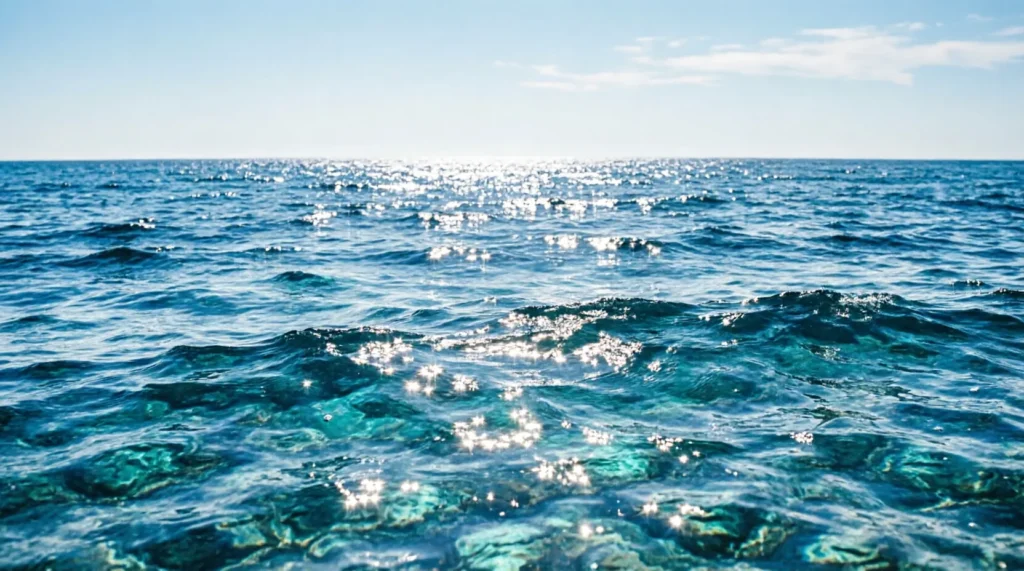
When writers reach for “as blue as the ocean,” they’re tapping into one of the English language’s most versatile comparisons. This simile can convey everything from crushing sadness to boundless possibility, depending on context. Below, you’ll find categorized examples showing how this phrase functions across different emotional registers, plus guidance on when to use it and when to craft something fresher.
What Is a Simile?
A simile is a figure of speech that directly compares two different things using “like” or “as” to highlight a shared quality. According to Simile, this rhetorical device creates vivid imagery by linking the familiar to the unfamiliar, making abstract concepts concrete for readers. The key distinction between a simile and a metaphor is that a simile maintains the separation between the two things being compared (using “like” or “as”), while a metaphor asserts that one thing is another, creating a more direct identification.
Emotional Depth and Melancholy
Blue has long been associated with sadness in Western culture, and the ocean’s vast, churning depths make it a perfect vehicle for expressing grief, loneliness, or depression. These similes work best when you need to convey emotions that feel overwhelming and inescapable.
- “Her mood was as blue as the ocean after a storm” — “She sat by the window, her mood as blue as the ocean after a storm.” (heavy, lingering sadness)
- “His heart sank, as blue as the ocean’s deepest trench” — “When she didn’t call, his heart sank, as blue as the ocean’s deepest trench.” (profound disappointment)
- “The room felt as blue as the ocean on a cloudy day” — “After the argument, the room felt as blue as the ocean on a cloudy day.” (oppressive gloom)
- “Tears made her eyes as blue as the ocean in winter” — “She wiped her face, tears having made her eyes as blue as the ocean in winter.” (raw, exposed vulnerability)
- “Grief wrapped around him, as blue as the ocean at midnight” — “Grief wrapped around him, as blue as the ocean at midnight.” (isolating, dark sorrow)
- “Her song carried a voice as blue as the ocean’s undertow” — “Her song carried a voice as blue as the ocean’s undertow, pulling at something deep in my chest.” (haunting, inescapable melancholy)
Craft note: The version my students always reach for first is “as blue as the ocean,” but it’s often too vague. Adding a specific condition—”after a storm,” “at midnight,” “in winter”—gives the emotion texture and makes it earned rather than stated.
Vastness and Limitless Possibility
The ocean’s horizon-less expanse makes it ideal for describing dreams, potential, or experiences that feel boundless. Use these when you want to convey scale, freedom, or infinite possibility.
- “Her ambition stretched, as blue as the ocean meeting the sky” — “Her ambition stretched, as blue as the ocean meeting the sky, with no visible end.” (limitless aspiration)
- “The future looked as blue as the ocean from a cliff” — “At eighteen, the future looked as blue as the ocean from a cliff—terrifying and beautiful.” (overwhelming potential)
- “His imagination was as blue as the uncharted ocean” — “His imagination was as blue as the uncharted ocean, full of territories no one had mapped.” (creative abundance)
- “Hope remained, as blue as the ocean’s surface at dawn” — “Even after the rejection, hope remained, as blue as the ocean’s surface at dawn.” (renewed, persistent optimism)
- “Their love felt as blue as the endless ocean” — “Their love felt as blue as the endless ocean, deeper than either of them could measure.” (profound, immeasurable connection)
- “The possibilities spread before her, as blue as the open ocean” — “The possibilities spread before her, as blue as the open ocean after graduation.” (liberating freedom)
Craft note: “As blue as the endless ocean” is borderline cliché at this point—it’s appeared in too many graduation speeches and wedding toasts. Swap “endless” for something more specific like “uncharted” or “unmeasured” to restore its power.
Beauty and Serenity
Not all ocean-blue similes carry weight or sadness. Sometimes the comparison captures tranquility, clarity, or aesthetic perfection. These work well in descriptive passages where you’re establishing atmosphere.
- “The lake was as blue as the ocean on a perfect summer day” — “The lake was as blue as the ocean on a perfect summer day, without a single ripple.” (peaceful, idyllic)
- “Her dress was as blue as the ocean’s clearest water” — “Her dress was as blue as the ocean’s clearest water, the color of tropical shallows.” (vibrant, refreshing)
- “The sky reflected in the pool, as blue as the ocean’s calmest moment” — “The sky reflected in the pool, as blue as the ocean’s calmest moment before sunrise.” (serene, meditative)
- “His eyes were as blue as the ocean where coral grows” — “His eyes were as blue as the ocean where coral grows, bright and full of life.” (vivid, engaging)
- “The gemstone shone, as blue as the ocean’s heart” — “The gemstone shone, as blue as the ocean’s heart, capturing light from every angle.” (precious, luminous)
- “Morning stretched before them, as blue as the ocean’s promise” — “Morning stretched before them, as blue as the ocean’s promise, fresh and unwritten.” (hopeful, clean)
According to Meaning, the significance we attach to colors like blue is culturally constructed, which explains why ocean-blue can simultaneously represent sadness in one context and peace in another—the meaning emerges from how we frame the comparison.
Mystery and the Unknown
The ocean’s depths remain largely unexplored, making it perfect for describing the unknowable, the secretive, or the dangerously attractive. These similes carry an edge of caution or intrigue.
- “His past was as blue as the ocean’s abyss” — “His past was as blue as the ocean’s abyss, dark and full of things she’d never understand.” (hidden, unknowable)
- “The truth lay hidden, as blue as the ocean’s deepest currents” — “The truth lay hidden, as blue as the ocean’s deepest currents, moving in ways no one could track.” (elusive, complex)
- “Her smile held secrets, as blue as the ocean’s midnight waters” — “Her smile held secrets, as blue as the ocean’s midnight waters, beautiful but dangerous.” (alluring, concealed)
- “The question hung between them, as blue as the ocean’s unexplored trenches” — “The question hung between them, as blue as the ocean’s unexplored trenches, too deep to navigate.” (unanswerable, profound)
- “His silence was as blue as the ocean’s crushing depths” — “His silence was as blue as the ocean’s crushing depths, heavy with pressure she couldn’t withstand.” (oppressive, overwhelming)
- “The city at night looked as blue as the ocean’s mysterious floor” — “The city at night looked as blue as the ocean’s mysterious floor, full of hidden life.” (enigmatic, alive)
Intensity and Overwhelming Force
Sometimes “as blue as the ocean” captures not depth but power—the sheer force of emotion or experience that crashes over you. These similes work when you need to convey intensity that feels unstoppable.
- “Rage hit him, as blue as the ocean’s breaking wave” — “Rage hit him, as blue as the ocean’s breaking wave, knocking everything else aside.” (sudden, violent)
- “Longing pulled at her, as blue as the ocean’s tide” — “Longing pulled at her, as blue as the ocean’s tide, impossible to resist.” (inescapable, rhythmic)
- “Fear washed over him, as blue as the ocean in a hurricane” — “Fear washed over him, as blue as the ocean in a hurricane, chaotic and consuming.” (panicked, overwhelming)
- “Joy flooded through her, as blue as the ocean’s sunlit surface” — “Joy flooded through her, as blue as the ocean’s sunlit surface, brilliant and boundless.” (euphoric, radiant)
- “Grief came in waves, as blue as the ocean’s relentless shore” — “Grief came in waves, as blue as the ocean’s relentless shore, returning no matter how far she walked.” (persistent, cyclical)
- “Desire burned, as blue as the ocean’s hottest flame” — “Desire burned, as blue as the ocean’s hottest flame, hotter than anything she’d known.” (intense, consuming)
Craft note: “As blue as the ocean’s hottest flame” is technically an oxymoron—oceans aren’t hot, flames aren’t blue in the way water is blue—but that tension is exactly what makes it memorable. My strongest student writers aren’t afraid to bend logic slightly if it serves the emotional truth.
How to Write Your Own Ocean-Blue Simile
Creating fresh similes requires moving beyond the default comparison. Here’s my three-step process:
- Identify the specific quality you’re comparing (Is it the color? The depth? The movement? The temperature?)
- Add a modifier that narrows the ocean’s infinite possibilities (time of day, weather condition, depth, location)
- Test it aloud to ensure the rhythm works with your sentence
Worked example: Instead of “Her sadness was as blue as the ocean” (generic), try “Her sadness was as blue as the ocean at 3 AM, when even the gulls have given up” (specific, atmospheric, earned).
Frequently Asked Questions
What does “as blue as the ocean” actually mean? The phrase doesn’t have a single fixed meaning—it’s context-dependent. It can describe sadness, vastness, beauty, mystery, or intensity depending on what surrounds it. The ocean itself carries all these associations, so the simile inherits whichever quality your sentence emphasizes.
Is “as blue as the ocean” a cliché? It’s borderline. The base comparison is overused, but you can refresh it by adding specific details (“as blue as the ocean after the monsoon,” “as blue as the ocean where the icebergs calve”). Specificity transforms cliché into craft.
When should I use this simile versus a metaphor? Use the simile when you want to maintain distance between the two things being compared—when you want readers to see the connection but also recognize the separation. Use a metaphor (“her sadness was the ocean”) when you want to create total identification, when the emotion becomes the thing itself.
Can I use “as blue as the ocean” for positive emotions? Absolutely. While blue often signals sadness, the ocean also represents freedom, beauty, and possibility. “Her excitement was as blue as the ocean on the morning of their voyage” works just as well as a melancholic usage—the surrounding words determine the emotional register.

Melissa Harris combines her background in creative writing with a keen analytical mind to bring a unique perspective on similes and figurative language. She holds a Bachelor of Arts in Creative Writing from the University of Iowa and a Ph.D. in Comparative Literature from Stanford University. Her love for the lyrical and the whimsical aspects of language drew her to specialize in figurative speeches, such as similes. With over a decade of experience as a writer and editor, Melissa is adept at breaking down complex figurative constructs into digestible insights for her audience. She is especially interested in the cognitive impact of similes in poetry and prose and enjoys experimenting with innovative approaches to simile creation in her writing. At SimileStation, Melissa contributes in-depth analysis pieces and creative exercises designed to spark imagination and refine readers’ use of similes. Her work inspires others to view language as an ever-evolving canvas, where words create a vivid tapestry of expression.