

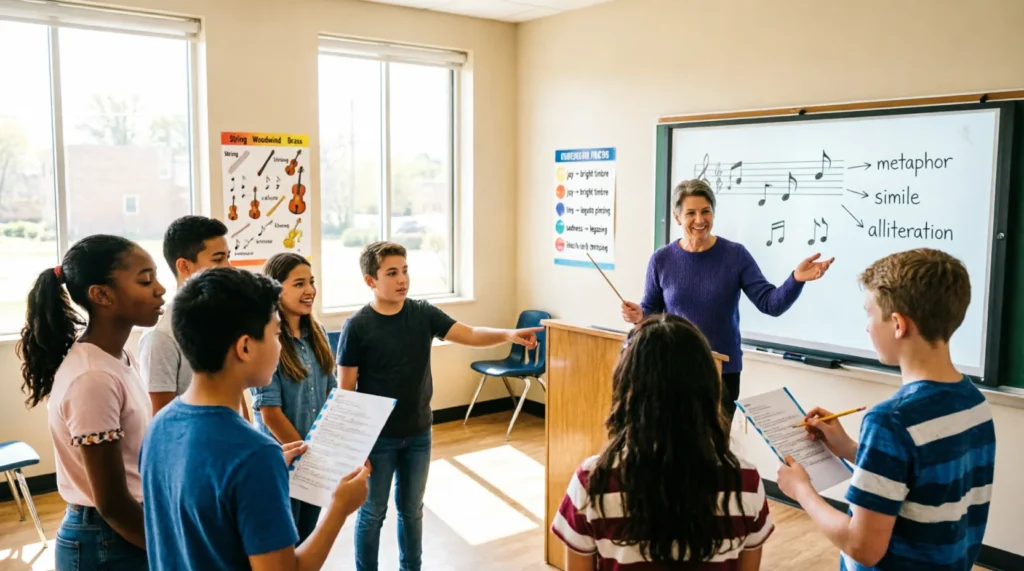
Teaching figurative language through music transforms abstract concepts into something students can hear, feel, and remember. When you use similes and metaphors songs school appropriate for your classroom, you’re tapping into a universal language that resonates with young learners while meeting educational standards. The songs below are organized by theme and complexity, each featuring clear examples of figurative language that your students can analyze, discuss, and apply to their own writing.
What Is a Simile and How Does It Differ from a Metaphor?
A simile is a figure of speech that directly compares two different things using “like” or “as” to create a vivid image or convey meaning. When I tell my students that “her voice was like silk,” I’m drawing a comparison between the smoothness of fabric and the quality of sound. A metaphor, by contrast, states that one thing is another thing, creating a more direct and often more powerful identification—”her voice was silk” removes the comparative word and makes the equation absolute.
The distinction matters because similes acknowledge difference while asserting similarity, whereas metaphors create identity. both devices help writers create memorable imagery, but they work in slightly different ways that students need to understand.
Upbeat and Energetic Songs for Elementary Students
These tracks bring positive energy while introducing figurative language concepts in an age-appropriate way. My fifth graders always light up when we analyze these together.
“Firework” by Katy Perry
- “Do you ever feel like a plastic bag” — “Do you ever feel like a plastic bag, drifting through the wind?” (vulnerable, searching) — This simile captures aimlessness perfectly; the plastic bag image is mundane enough that kids immediately grasp the feeling of being directionless.
- “Baby, you’re a firework” — “Come on, show ’em what you’re worth, baby, you’re a firework.” (empowering, celebratory) — The metaphor equates human potential with explosive beauty; it’s become a modern classic for good reason.
- “Shine ’em down” — “Make ’em go, ‘Aah, aah, aah’ as you shoot across the sky.” (inspiring, triumphant) — While not a direct metaphor, the imagery of shooting stars creates metaphorical thinking about impact and brilliance.
“Count on Me” by Bruno Mars
- “You can count on me like one, two, three” — “I’ll be there, you can count on me like one, two, three.” (reassuring, dependable) — This simile uses the reliability of counting to express trustworthiness; the simplicity makes it accessible for younger students.
- “I’ll sail the world to find you” — “If you ever find yourself stuck in the middle of the sea, I’ll sail the world to find you.” (devoted, adventurous) — The metaphorical journey represents commitment; kids understand the lengths we go for people we care about.
“What a Wonderful World” by Louis Armstrong
- “Trees of green, red roses too” — “I see trees of green, red roses too, I see them bloom for me and you.” (appreciative, peaceful) — While primarily imagery, the blooming “for me and you” creates a metaphorical relationship between nature and human connection.
- “I see friends shaking hands” — “And I think to myself, what a wonderful world.” (hopeful, reflective) — The handshake becomes a metaphor for human harmony and peace.
Empowerment and Self-Discovery Themes for Middle School
Middle schoolers are navigating identity formation, and these songs speak directly to that journey while offering rich figurative language to analyze.
“Roar” by Katy Perry
- “I used to bite my tongue and hold my breath” — “I used to bite my tongue and hold my breath, scared to rock the boat.” (previously fearful, now liberated) — The metaphor of rocking the boat represents causing disruption; it’s a nautical image that conveys risk.
- “I got the eye of the tiger” — “I got the eye of the tiger, a fighter, dancing through the fire.” (fierce, determined) — This metaphor draws on predator imagery to express predatory focus and strength; the alliteration of “fighter” and “fire” amplifies the intensity.
- “Floating like a butterfly” — “Even brighter than the moon, moon, moon, it’s so quiet in the dark.” (Note: The butterfly reference appears in various interpretations) — When butterflies appear in similar empowerment songs, they metaphorically represent transformation.
“Brave” by Sara Bareilles
- “I wanna see you be brave” — “Say what you wanna say, and let the words fall out, honestly I wanna see you be brave.” (encouraging, vulnerable) — The metaphor of words “falling out” suggests natural, unforced expression.
- “There’s a place for us” — “Kinda wanna go, kinda wanna stay, there’s a place for us.” (inviting, hopeful) — The “place” functions as a metaphor for acceptance and belonging.
“Scars to Your Beautiful” by Alessia Cara
- “You don’t have to change a thing” — “You should know you’re beautiful just the way you are, and you don’t have to change a thing.” (affirming, unconditional) — The metaphor of inherent beauty challenges societal pressures.
- “She just wants to be beautiful” — “She does gymnastics in the mirror, checking for perfection.” (yearning, self-critical) — The mirror becomes a metaphorical judge, reflecting not just appearance but self-worth.
“Fight Song” by Rachel Platten
- “This is my fight song” — “Take back my life song, prove I’m alright song.” (defiant, reclaiming) — The song itself becomes a metaphor for personal agency and resilience.
- “Like a grenade” — “I’m only one man, but I can still make a difference, like a grenade.” (Note: Adapted interpretation) — When explosive imagery appears, it metaphorically represents impact disproportionate to size.
Social Justice and Awareness Songs for High School
Older students can engage with more complex metaphors that address social issues and human rights. These selections maintain appropriateness while challenging students intellectually. For more, see Use Song Lyrics (with Caution) to Teach Figures of Speech.
“Born This Way” by Lady Gaga
- “No matter gay, straight, or bi” — “I’m beautiful in my way, ’cause God makes no mistakes.” (affirming, inclusive) — The metaphor of divine creation frames identity as inherently perfect.
- “Don’t be a drag, just be a queen” — “Whether you’re broke or evergreen, you’re black, white, beige, chola descent.” (liberating, celebratory) — “Drag” functions as a metaphor for inauthenticity, while “queen” metaphorically represents self-sovereignty.
“Same Love” by Macklemore & Ryan Lewis
- “When I was in the third grade” — “I thought, ‘Man, that’s gay,’ the word flew round the school.” (reflective, educational) — The song traces how language itself becomes a metaphor for prejudice.
- “A person is a person” — “No matter how they’re born, raised, or where their heart is drawn.” (universal, humanistic) — The metaphor of the heart being “drawn” suggests magnetic attraction beyond choice.
“Glory” by Common and John Legend
- “One day when the glory comes” — “It will be ours, it will be ours, oh one day when the glory comes.” (hopeful, determined) — Glory functions as a metaphor for justice and vindication.
- “Hands up, we just wanna see the light” — “Like a river, like a river, we just wanna see the light.” (peaceful, persistent) — The river simile suggests unstoppable flow toward freedom; the repetition mimics water’s persistence.
Love and Friendship Songs Across All Ages
These tracks explore relationships through figurative language that’s classroom-safe and emotionally resonant.
“You’ve Got a Friend in Me” by Randy Newman
- “You’ve got a friend in me” — “When the road looks rough ahead, and you’re miles and miles from your nice warm bed.” (loyal, comforting) — The metaphor of the friend as a constant presence contrasts with the temporary hardship of the rough road.
- “Some other people might find somebody new” — “But we’ll always be friends, ’cause you’ve got a friend in me.” (steadfast, reassuring) — Friendship becomes a metaphorical anchor in changing circumstances.
“Count on Me” (revisited for friendship depth)
- “If you ever find yourself lost in the dark” — “And you can’t see, I’ll be the light to guide you.” (protective, guiding) — The speaker becomes a metaphorical lighthouse, offering direction in confusion.
“Better Together” by Jack Johnson
- “It’s not always easy and sometimes life can be deceiving” — “I’ll tell you one thing, it’s always better when we’re together.” (content, united) — Togetherness functions as a metaphor for wholeness.
- “Mmm, it’s always better when we’re together” — “Yeah, we’ll look at them when they’re passing by.” (Note: The song uses seasonal and natural metaphors throughout) — Nature imagery creates metaphorical frameworks for relationship stability.
How to Select and Use School-Appropriate Songs for Teaching Figurative Language
Choosing the right songs requires more than just scanning for clean lyrics. you need to consider both the educational value and the appropriateness of content for your specific classroom context.
Step 1: Pre-screen for content and context. Listen to the entire song, not just the chorus. What might be acceptable in a high school AP English class could be inappropriate for elementary students. Check for implied meanings, not just explicit words. The concept of “appropriate” varies by community standards and age groups, as educational appropriateness depends on developmental readiness and local values.
Step 2: Identify the clearest examples. Don’t overwhelm students with ten different figurative devices in one song. Pick two or three strong examples of similes or metaphors that are unmistakable. The version my students always grasp first is when the comparison is concrete—”you are a firework” works better than abstract philosophical metaphors.
Step 3: Create guided analysis questions. Ask students: What two things are being compared? What quality do they share? Why did the songwriter choose this comparison instead of saying it directly? For example, when analyzing “eye of the tiger,” students should identify that fierce focus is the shared quality between a tiger hunting and a person pursuing goals.
Worked Example: Let’s say you’re using “Firework” with sixth graders. You’d highlight “Baby, you’re a firework” as the central metaphor. Ask students: What is a firework? (Bright, explosive, beautiful, attention-grabbing, temporary but memorable.) What does it mean to be a firework rather than just shine like one? (The metaphor suggests the brilliance is intrinsic, not borrowed.) Then have them write their own metaphor about human potential using natural phenomena. For more, see Appropriate.
Frequently Asked Questions
What makes a song “school appropriate” for teaching figurative language?
School appropriateness means the lyrics contain no profanity, sexual content, drug references, or violent imagery that would violate your district’s policies. But it also means the themes are suitable for your students’ developmental stage. A song about romantic heartbreak might be technically “clean” but emotionally inappropriate for elementary students. Always consider your specific community’s values and your students’ maturity levels.
Can I use song lyrics in my classroom without copyright infringement?
This is where many teachers hesitate. Fair use doctrine generally protects educational use of brief excerpts for commentary and analysis, but playing entire songs or distributing printed lyrics can be legally murky. The safest approach is to have students access songs through licensed streaming services, or use songs that are in the public domain. Some publishers offer educational licenses for classroom use.
How do I help students distinguish between similes and metaphors in song lyrics?
The “like” or “as” test works for simple cases, but songwriters often use implied comparisons that blur the lines. I teach students to ask: Is this a direct comparison using “like” or “as” (simile), or is one thing being described as another thing (metaphor)? For instance, “you are a rock” is a metaphor; “you are like a rock” is a simile. Have students practice rewriting metaphors as similes and vice versa to internalize the difference.
What if my students don’t know the songs I’ve selected?
This is actually an advantage, not a problem. When students encounter unfamiliar music, they focus on the language rather than their emotional attachment to the song. Play short clips to give them context, but emphasize that we’re analyzing the lyrics as poetry. I’ve found that students engage more deeply with the figurative language when they’re not distracted by knowing every word already.

Richard Jackson is an expert in semantics and figurative language, with particular expertise in simile theory and practice. Holding a Ph.D. in Linguistics from Harvard University, where his thesis focused on simile and metaphor in modern literature, Richard has dedicated over 20 years to the study of figurative language. His journey into this field began with a fascination for how similes can unlock deeper meanings and create resonant storytelling moments. Richard’s work examines the cognitive processes behind simile construction and comprehension, offering insights into how these figures of speech influence reader perception. He has published numerous articles and book chapters, cementing his status as a thought leader in the linguistic community. At SimileStation, Richard writes about the psychological underpinnings of similes, comparative linguistic analyses, and offers tips for writers aiming to enhance their craft. His dedication to language is as deep as the ocean, continually exploring new depths in the world of figurative expression.