

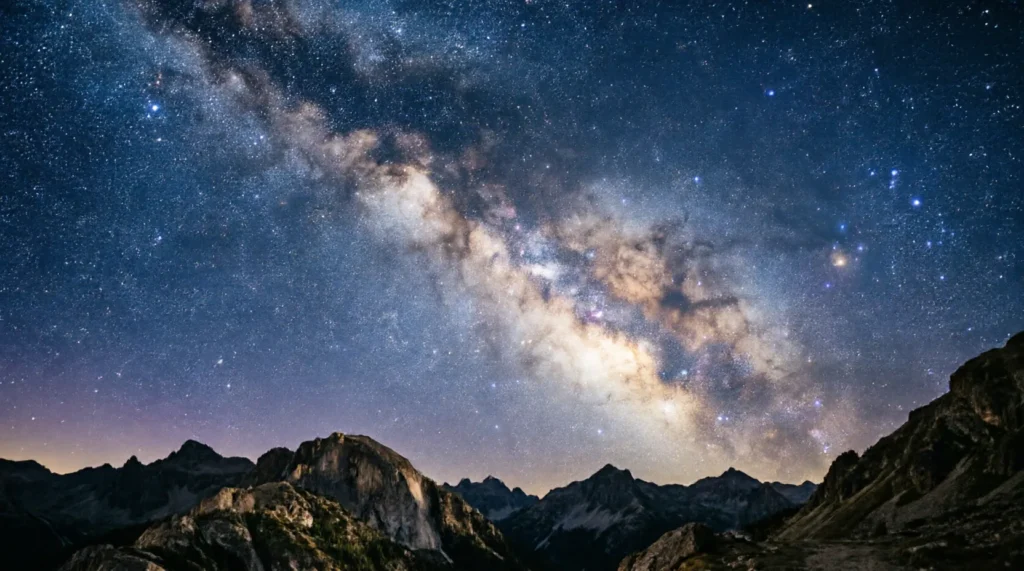
A well-chosen simile for stars at night transforms a flat description into a vivid, atmospheric scene that pulls the reader directly under the sky. Below, you will find categorized, ready-to-use comparisons, each placed inside a real sentence so you can see exactly how the rhythm and tone land on the page.
Piercing Brightness and Sharp Light
When you need the night sky to feel intense, cold, or striking, focus on similes that emphasize sharp edges and sudden illumination. These work beautifully in thriller openings or moments of sudden clarity.
- “like shattered glass” — “The winter stars hung above the pines like shattered glass.” (sharp, striking). Craft note: The hard ‘sh’ and ‘gl’ consonants mimic the sharp, cold visual of ice and light.
- “as bright as a struck match” — “In the pitch black of the canyon, the first stars appeared as bright as a struck match.” (sudden, vivid).
- “like diamond dust” — “She looked up at the Milky Way, spilled across the dark like diamond dust.” (luxurious, sparkling). Craft note: This works because it shifts the scale from a single gem to an infinite spray, capturing the sheer volume of the galaxy.
- “like pinpricks in black velvet” — “The desert sky was pinned with stars, like pinpricks in black velvet.” (classic, tactile). Note: This is bordering on cliché, so use it only if you specifically need a cozy, tactile feel.
- “as fierce as a welder’s spark” — “The brightest star burned as fierce as a welder’s spark against the city smog.” (industrial, intense).
- “like white-hot needles” — “The cold stars pierced the fog like white-hot needles.” (aggressive, piercing).
Distant, Cold, and Untouchable
While Stars are technically massive, luminous spheres of plasma, to a human observer on Earth, they often feel like fragile, unreachable points of light. These similes capture that profound isolation and emotional distance.
- “like frozen coins” — “The stars looked down on the frozen lake like frozen coins.” (bleak, transactional).
- “as distant as a forgotten promise” — “He stared at the sky, the stars as distant as a forgotten promise.” (melancholic, emotional). Craft note: This bridges the physical distance of space with emotional distance, a technique that grounds abstract astronomy in human feeling.
- “like dust on a high shelf” — “The city lights washed out the sky, leaving only a few stars hanging up there like dust on a high shelf.” (neglected, faint).
- “as unreachable as the bottom of the sea” — “She reached for the stars, but they were as unreachable as the bottom of the sea.” (paradoxical, yearning).
- “like ice crystals in a vacuum” — “The stars hung in the upper atmosphere like ice crystals in a vacuum.” (scientific, sterile).
- “as cold as a dead man’s eyes” — “The night sky was clear, but the stars stared down as cold as a dead man’s eyes.” (noir, grim).
Gentle, Watchful, and Comforting
Not every night sky needs to be harsh or indifferent. When writing a scene of comfort, nostalgia, or quiet reflection, use similes that frame the stars as gentle companions.
- “like old friends” — “The familiar constellations appeared like old friends.” (warm, nostalgic).
- “as steady as a nightlight” — “Through the nursery window, the stars shone as steady as a nightlight.” (protective, soft).
- “like silver fireflies” — “The children chased the low-hanging stars, which blinked like silver fireflies.” (playful, whimsical). Craft note: Fireflies imply movement and life, which breathes energy into a static night sky and makes the scene feel magical.
- “as patient as a waiting mother” — “The moon and stars watched over the valley as patient as a waiting mother.” (nurturing, calm).
- “like scattered salt” — “He sprinkled the imaginary stars across the dark canvas like scattered salt.” (domestic, simple).
- “as gentle as falling snow” — “The starlight settled over the quiet town as gentle as falling snow.” (peaceful, hushed).
Scattered, Faint, and Fleeting
Modern writers often need to describe skies ruined by light pollution or viewed through a distracted, urban lens. These similes capture the frustration and subtlety of a compromised night sky.
- “like ash from a cigarette” — “The smoggy sky held a few dying stars, drifting like ash from a cigarette.” (gritty, polluted).
- “as faint as a whisper in a crowd” — “In the glare of the stadium, the stars were as faint as a whisper in a crowd.” (overpowered, subtle).
- “like stray thoughts” — “The scattered stars drifted across his mind like stray thoughts.” (internal, distracted).
- “as fragile as spun sugar” — “The thin clouds dissolved the starlight, leaving them as fragile as spun sugar.” (delicate, temporary).
- “like static on a radio” — “The light pollution reduced the grand cosmos to a few stars, flickering like static on a radio.” (modern, annoying).
- “as sparse as teeth in a hound dog’s mouth” — “The rural sky wasn’t as full as he remembered; the stars were as sparse as teeth in a hound dog’s mouth.” (folksy, humorous).
Mythic, Timeless, and Grand
Sometimes you need the night sky to feel epic, ancient, or sacred. These similes elevate the stars from mere rocks burning in space to something that commands awe and reverence.
- “like ancient runes” — “The constellations traced across the sky like ancient runes.” (mystical, historical). Craft note: Comparing stars to runes taps into humanity’s oldest habit of reading the sky for meaning, adding instant gravitas to your prose.
- “as old as the dust” — “The stars burned as old as the dust.” (biblical, epic).
- “like a spilled handful of pearls” — “The galaxy stretched out like a spilled handful of pearls.” (opulent, careless).
- “as eternal as the ocean” — “The waves crashed below stars that looked as eternal as the ocean.” (vast, enduring).
- “like the eyes of forgotten gods” — “The silent peaks were watched by stars, glowing like the eyes of forgotten gods.” (awe-inspiring, intimidating).
- “as vast as a cathedral” — “Looking up, the starry expanse felt as vast as a cathedral.” (sacred, echoing).
How to write your own simile for stars at night
According to Simile, the core mechanism of this figure of speech is comparing two unlike things using “like” or “as” to highlight a shared trait. When you are crafting your own comparisons for the night sky, follow these three steps to keep them fresh.
First, isolate the specific quality of the stars you want to highlight. Are they flickering, cold, distant, or blurry? Second, find a concrete, everyday object that shares that exact quality, but actively avoid the first thing that comes to mind. Skip “diamonds,” “jewels,” and “eyes.” Third, test the rhythm by reading the sentence aloud; a good simile should snap into place without dragging the pacing down.
Here is a worked example from my own drafting process. I needed to describe stars seen through the window of a moving train. The key quality was that they were blurred and streaking. My first instinct was to compare them to “streaks of light,” which is boring. I pushed further and thought of “wet paint on a passing fence.” The final sentence was: “The stars dragged across the glass like wet paint on a passing fence.” It grounds a celestial event in a highly specific, mundane reality.
Frequently Asked Questions
What is the most common simile for stars? “Like diamonds in the sky” is the most common, but it is heavily overused and reads as lazy in serious fiction. I strongly recommend avoiding it and opting for fresher, more tactile comparisons like “like shattered glass” or “like scattered salt.”
Can a simile for stars at night be negative? Absolutely. Stars are often romanticized, but they can also be cold, indifferent, or blotted out by pollution. Similes like “as cold as a dead man’s eyes” or “like ash from a cigarette” work perfectly for noir, horror, or dystopian settings where the environment feels hostile.
How do I make my star simile sound poetic without being cheesy? Focus on unexpected sensory details rather than abstract beauty. Instead of telling the reader the stars are “beautiful” or “sparkling,” compare their physical behavior to something tangible and slightly unexpected, such as “like ice crystals in a vacuum” or “like silver fireflies.”
Should I use “like” or “as” for star similes? Both are grammatically correct, but they create different rhythms. “Like” is punchier and more direct, making it great for fast-paced scenes. “As” feels slightly more formal and drawn out, which works well for lyrical, sweeping descriptions of the cosmos.

Melissa Harris combines her background in creative writing with a keen analytical mind to bring a unique perspective on similes and figurative language. She holds a Bachelor of Arts in Creative Writing from the University of Iowa and a Ph.D. in Comparative Literature from Stanford University. Her love for the lyrical and the whimsical aspects of language drew her to specialize in figurative speeches, such as similes. With over a decade of experience as a writer and editor, Melissa is adept at breaking down complex figurative constructs into digestible insights for her audience. She is especially interested in the cognitive impact of similes in poetry and prose and enjoys experimenting with innovative approaches to simile creation in her writing. At SimileStation, Melissa contributes in-depth analysis pieces and creative exercises designed to spark imagination and refine readers’ use of similes. Her work inspires others to view language as an ever-evolving canvas, where words create a vivid tapestry of expression.