

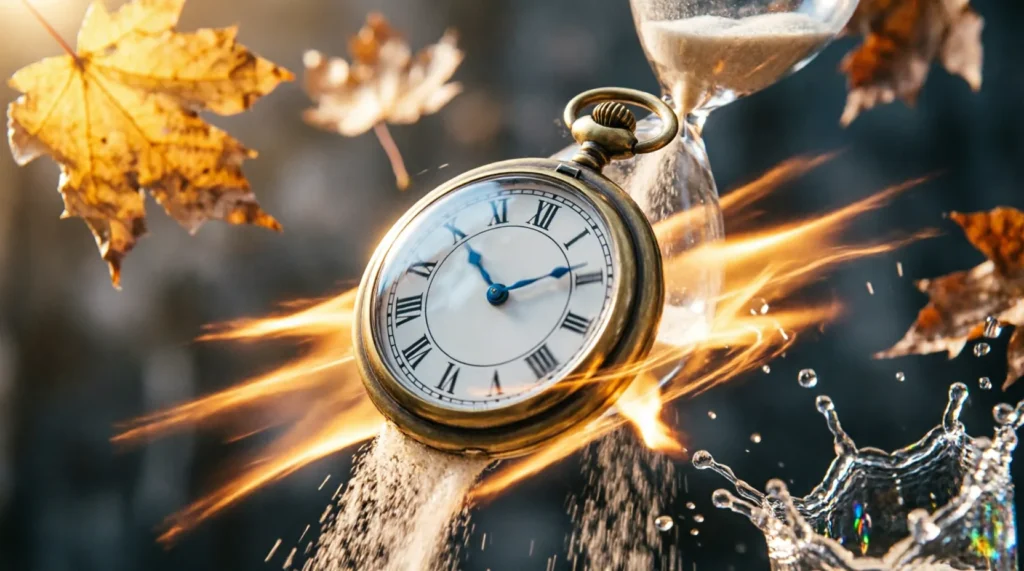
Time is the one resource we can never get back, yet it often feels like it’s slipping through our fingers before we’ve even noticed it’s there. When you’re trying to capture that breathless sensation of years vanishing or hours evaporating, generic phrases like “time flies” rarely cut it. You need imagery that hits the reader in the gut. The examples below are categorized by emotion and context, giving you ready-to-use metaphors about time moving fast that feel fresh, specific, and emotionally resonant.
What Is a Metaphor?
Before we dive into the examples, let’s clarify the tool we’re using. A metaphor is a figure of speech that describes an object or action in a way that isn’t literally true but helps explain an idea or make a comparison Source: Wikipedia. Unlike a simile, which uses “like” or “as” to compare two things (e.g., “time is like a river”), a metaphor states that one thing is another (e.g., “time is a thief”). This direct identification creates a stronger, more immediate impact, forcing the reader to see the subject in a new light. While similes are gentle suggestions, metaphors are bold assertions.
The Violent Rush: Time as a Force of Nature
Sometimes time doesn’t just pass; it assaults us. These metaphors work best when you’re describing trauma, sudden loss, or the shock of realizing how much has changed. They convey a lack of control and the sheer physical weight of passing years.
- “Time is a riptide pulling me out to sea.” — “I blinked, and ten years were gone; time is a riptide pulling me out to sea.” (overwhelming, dangerous)
- Craft Note: This works because it invokes a specific, terrifying physical sensation. Everyone knows the panic of being pulled under; it’s not just fast, it’s deadly.
- “The years were a landslide, burying everything I knew.” — “We didn’t drift apart; the years were a landslide, burying everything I knew.” (destructive, sudden)
- “Time is a hurricane that stripped the house bare.” — “Looking at the empty nursery, I realized time is a hurricane that stripped the house bare.” (devastating, empty)
- “My childhood was a flash flood, here and then gone.” — “One day I was building forts, the next I was paying taxes; my childhood was a flash flood, here and then gone.” (unexpected, chaotic)
- “Time is a freight train with no brakes.” — “Since the diagnosis, time is a freight train with no brakes, roaring toward a wall I can’t see.” (inevitable, loud)
- Craft Note: The auditory element (“roaring”) adds a layer of sensory urgency that visual metaphors often miss. It’s not just fast; it’s noisy and terrifying.
- “The decade was a tsunami, wiping the slate clean.” — “We survived the war, but the peace was harder; the decade was a tsunami, wiping the slate clean.” (erasing, powerful)
- “Time is a wild horse I can’t rein in.” — “I tried to slow down, but time is a wild horse I can’t rein in.” (frustrating, untamable)
- “Years are avalanches, silent until they crush you.” — “I didn’t notice the stress building until I broke; years are avalanches, silent until they crush you.” (deceptive, heavy)
The Slippery Escape: Time as Something You Can’t Hold
These metaphors focus on the frustration of trying to preserve moments. They are perfect for nostalgic pieces, memoirs, or reflections on aging where the primary emotion is regret or longing.
- “Time is water slipping through cupped hands.” — “I tried to remember her voice clearly, but time is water slipping through cupped hands.” (futile, fluid)
- Craft Note: This is a classic for a reason. It’s tactile. You can feel the wetness and the emptiness. It’s overused in casual conversation, but in literary prose, it still lands if you focus on the sensation of the cold water or the grit left behind.
- “Memories are smoke, dissolving before I can grasp them.” — “His face is fading; memories are smoke, dissolving before I can grasp them.” (ephemeral, intangible)
- “Time is sand running through an hourglass with a crack.” — “We wasted so much of it; time is sand running through an hourglass with a crack.” (wasteful, leaking)
- “The past is a dream upon waking.” — “Trying to recall the exact words he said is futile; the past is a dream upon waking.” (elusive, fragile)
- “Time is a thief picking my pocket.” — “I turned around and my youth was gone; time is a thief picking my pocket.” (stealthy, personal)
- Craft Note: Personifying time as a criminal adds anger to the grief. It’s not just natural; it’s malicious. This shifts the tone from sad to resentful.
- “Moments are bubbles, beautiful until they pop.” — “We laughed in the kitchen, knowing it wouldn’t last; moments are bubbles, beautiful until they pop.” (fragile, transient)
- “Time is oil on water, impossible to contain.” — “My plans spread out and vanished; time is oil on water, impossible to contain.” (slippery, messy)
- “The years are mist burning off in the sun.” — “I looked for the girl I used to be, but the years are mist burning off in the sun.” (vanishing, natural)
The Mechanical Grind: Time as a Machine
When time feels impersonal, industrial, or relentless, mechanical metaphors hit hard. These are excellent for dystopian fiction, critiques of modern work culture, or descriptions of burnout. They strip away the romance of nature and replace it with cold efficiency.
- “Time is a conveyor belt that never stops.” — “I stood still, but life moved on; time is a conveyor belt that never stops.” (relentless, industrial)
- “The clock is a guillotine, dropping second by second.” — “Every tick felt like a threat; the clock is a guillotine, dropping second by second.” (menacing, precise)
- Craft Note: This is aggressive. It turns a neutral object (a clock) into an instrument of execution. Use this when the character feels trapped or sentenced.
- “Life is a film reel spinning too fast to see.” — “The holidays blurred together; life is a film reel spinning too fast to see.” (disorienting, visual)
- “Time is a engine revving in neutral.” — “I was working hard but going nowhere; time is an engine revving in neutral.” (wasteful, loud)
- “The days are gears grinding against each other.” — “There was no smoothness left in our routine; the days are gears grinding against each other.” (harsh, friction-filled)
- “Time is a printer jamming on the last page.” — “The project deadline loomed; time is a printer jamming on the last page.” (frustrating, stuck)
- “Years are tickets punched on a commuter card.” — “I looked at my life and saw only routine; years are tickets punched on a commuter card.” (mundane, repetitive)
- “Time is a software update you can’t cancel.” — “I wasn’t ready for the change, but time is a software update you can’t cancel.” (forced, modern)
The Natural Cycle: Time as Seasons and Light
For a softer, more poetic approach, look to the natural world. These metaphors are less about violence and more about inevitability. They work well in lyrical essays, eulogies, or romantic reflections where the tone is bittersweet rather than panicked.
- “Time is autumn leaves falling faster each day.” — “The children grew up while I watched; time is autumn leaves falling faster each day.” (melancholic, beautiful)
- “Our youth was a sunset, brilliant but brief.” — “We burned bright and fast; our youth was a sunset, brilliant but brief.” (romantic, fading)
- Craft Note: The color imagery here is strong. It allows you to describe the “gold” and “red” of the past, making the loss feel vibrant rather than just empty.
- “Time is a river widening into the sea.” — “My options narrowed as I aged; time is a river widening into the sea.” (expansive, final)
- “The years are shadows lengthening across the lawn.” — “I sat on the porch and watched the day end; the years are shadows lengthening across the lawn.” (quiet, observational)
- “Time is snow melting on a warm stone.” — “Her anger dissolved quickly; time is snow melting on a warm stone.” (gentle, irreversible)
- “Life is a candle burning at both ends.” — “She worked two jobs and raised three kids; life is a candle burning at both ends.” (exhausting, bright)
- “Time is the tide pulling back from the shore.” — “The memories receded, leaving only shells; time is the tide pulling back from the shore.” (natural, rhythmic)
- “The decades are rings in a tree trunk.” — “You can’t see them from the outside, but they’re there; the decades are rings in a tree trunk.” (hidden, structural)
How to Write Your Own Time Metaphor
Creating a fresh metaphor is easier than you think if you follow a simple three-step process. First, identify the emotion you want to convey. Is time feeling violent? Sad? Neutral? Second, choose a concrete object or force that shares that emotional quality. Don’t just pick “fast” things; pick things that feel like your specific experience of time. Third, test the connection. Does it hold up under scrutiny? For more, see Moving.
Worked Example: Let’s say you’re writing about how fast time moves when you’re having fun with friends.
- Emotion: Joyful, fleeting, slippery.
- Object: A soap bubble? A sparkler? A handful of confetti? Let’s go with a sparkler. It’s bright, exciting, and burns out quickly.
- Draft: “The night was a sparkler, hissing and bright, then suddenly dark.”
Notice how this is better than “time flew.” It gives us sound (“hissing”), sight (“bright”), and a clear ending (“dark”). It’s specific to the kind of fast time we’re talking about.
Frequently Asked Questions
Why are metaphors better than similes for describing time? Metaphors create a stronger sense of identity between the subject and the image. Saying “time is a thief” feels more definitive and urgent than “time is like a thief.” In creative writing, metaphors often carry more emotional weight because they don’t ask for permission to compare; they assert the comparison as truth.
How do I avoid clichés when writing about time? Avoid the most common images: flying arrows, rivers flowing, and ticking clocks. Instead, look for unexpected sources. Think about modern technology (software updates, buffering screens), specific natural phenomena (ice cracking, dew evaporating), or domestic objects (melting ice cubes, draining sinks). The more specific the image, the less cliché it feels.
Can I mix metaphors in the same paragraph? Generally, no. Mixing metaphors (e.g., “Time is a river that crashed like a wave”) confuses the reader and dilutes the impact. Stick to one central image per paragraph or section. If you need to shift images, do it in a new paragraph with a clear transition.
What is the difference between a metaphor and personification? Personification gives human traits to non-human things (e.g., “Time waited for no one”). A metaphor compares two unlike things (e.g., “Time is a waiter who never brings the check”). You can combine them—”Time is a rude waiter”—but they are distinct tools. Personification focuses on behavior; metaphor focuses on identity.

Kenneth White is a seasoned linguist with over 15 years of experience in studying and teaching figurative language. He earned his Master’s degree in English Literature from Yale University, where he developed a deep interest in the art of similes and metaphors. His fascination with how similes enhance storytelling and evoke vivid imagery has been a guiding force throughout his career. Kenneth has conducted numerous workshops and seminars, educating students and fellow writers on effectively incorporating similes into their work. He has authored several papers detailing the evolution of simile usage across different literary periods. At SimileStation, Kenneth focuses on exploring the historical significance of similes and how they reflect cultural contexts. His articles dissect famous literary works, highlighting the creative use of figurative language to inspire emerging writers. Kenneth’s passion for language is as unwavering as a lighthouse in a storm, guiding readers through the complexities of simile construction and application.