

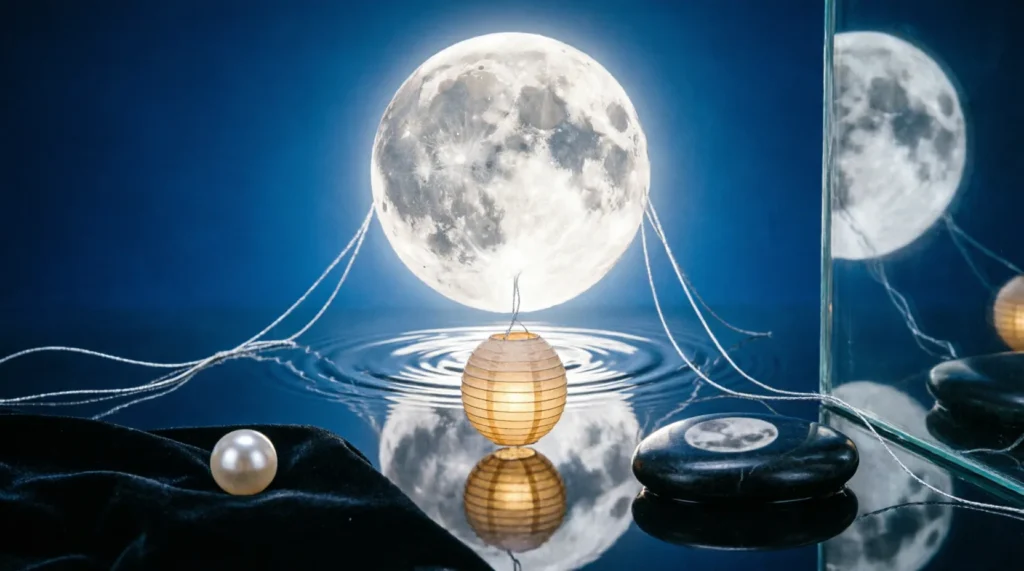
The moon is one of literature’s most enduring subjects, yet describing it without falling into cliché is surprisingly difficult. When you reach for a simile to capture its glow, shape, or presence, you want language that feels fresh rather than recycled. The examples below offer a curated collection of comparisons ranging from the starkly realistic to the deeply poetic, each embedded in a sentence so you can see exactly how they function in context. Use these to replace tired phrases like “bright as a button” with imagery that actually resonates with your reader’s senses.
Celestial and Ethereal Comparisons
These similes emphasize the moon’s otherworldly nature, its distance, and its cold, detached beauty. They work best when you want to create a sense of awe, isolation, or mystery.
- “like a pearl dropped in ink” — “The full moon hung in the sky like a pearl dropped in ink.” (elegant, high-contrast). This comparison works because it captures both the color contrast and the precious, smooth quality of the light.
- “as distant as a forgotten memory” — “Her gaze was fixed on the window, watching the moon rise as distant as a forgotten memory.” (melancholic, introspective). I often tell my students that this simile does double duty: it describes the object while simultaneously revealing the character’s internal state.
- “like a ghost ship sailing the night” — “Clouds parted to reveal the moon, floating like a ghost ship sailing the night.” (eerie, slow-moving). The rhythm of “ghost ship sailing” mimics the slow drift of clouds across the lunar surface.
- “as cold as a surgeon’s scalpel” — “The winter moonlight cut through the trees, as cold as a surgeon’s scalpel.” (sharp, clinical). This is a strong choice for thriller or horror contexts where the moon feels threatening rather than romantic.
- “like a silver coin tossed into a well” — “He looked up to see the moon, small and round like a silver coin tossed into a well.” (distant, unreachable). The auditory implication of the “well” adds depth to the visual image.
- “as pale as a sheet of bone” — “The crescent moon curved above the horizon, as pale as a sheet of bone.” (stark, mortal). This strips away the romance of the moon and replaces it with something primal and skeletal.
- “like a lantern held by a giant” — “The harvest moon rose slowly, like a lantern held by a giant walking over the hills.” (mythic, large-scale). This gives the moon a sense of agency and immense scale.
- “as silent as a held breath” — “We stood on the beach, watching the moon ascend, as silent as a held breath.” (tense, anticipatory). This simile transfers the physical sensation of silence onto the visual experience.
Domestic and Everyday Objects
Sometimes the most powerful descriptions come from grounding the celestial in the mundane. These similes make the moon feel accessible, tangible, and part of our daily lives. They are particularly effective in contemporary fiction or personal essays where you want to avoid overly flowery language.
- “like a thumbprint on dark glass” — “The smudged moon appeared through the storm clouds, like a thumbprint on dark glass.” (imperfect, intimate). This is one of my favorite comparisons because it acknowledges the messiness of real observation. The moon is rarely perfect; it’s often obscured, and this simile honors that reality.
- “as round as a dinner plate” — “She set the table outside, the moon hanging above us as round as a dinner plate.” (homely, comforting). This removes the mystique and replaces it with warmth and familiarity.
- “like a hole punched in the sky” — “The new moon was invisible, but the stars around it looked like a hole punched in the sky.” (negative space, stark). Technically, this describes the absence of the moon, but it’s a powerful way to evoke its presence through what’s missing.
- “as bright as a streetlamp on fog” — “The moon glowed through the mist, as bright as a streetlamp on fog.” (urban, diffused). This grounds the celestial body in an urban environment, making it feel part of the cityscape.
- “like a wet stone in a riverbed” — “The moon reflected on the lake, smooth and gray like a wet stone in a riverbed.” (textural, calm). This focuses on the reflection rather than the source, which can be a more subtle way to include the moon in a scene.
- “as thin as a clipped fingernail” — “The crescent moon was sharp and white, as thin as a clipped fingernail.” (precise, delicate). This captures the specific geometry of a thin crescent better than generic “sliver” comparisons.
- “like a nightlight left on” — “For the children afraid of the dark, the moon was simply a nightlight left on.” (reassuring, childish). This shifts the perspective to a child’s viewpoint, changing the emotional weight of the image entirely.
- “as flat as a pancake” — “In the heat haze, the rising moon looked distorted, as flat as a pancake.” (humorous, observational). This is useful for comedic or realistic scenes where atmospheric distortion plays a role.
Emotional and Atmospheric Moods
The moon often serves as a mirror for human emotion. These similes link the lunar appearance to specific feelings, allowing you to show rather than tell the mood of a scene. a simile is a figure of speech that directly compares two different things, usually employing the words “like” or “as.” In this context, we are comparing the moon’s visual attributes to emotional states.
- “like a watchful eye” — “The full moon stared down at the campsite, like a watchful eye.” (paranoid, exposed). This taps into the primal fear of being seen when you think you are alone.
- “as lonely as a lighthouse” — “The moon hung over the empty ocean, as lonely as a lighthouse.” (isolated, steadfast). Both the moon and a lighthouse are solitary beacons, making this a structurally sound comparison.
- “like a bruise on the sky” — “The red moon rose through the smoke, like a bruise on the sky.” (painful, ominous). Color is crucial here; a blue or yellow moon wouldn’t work, but a blood moon fits this violent imagery perfectly.
- “as steady as a heartbeat” — “Through the chaos of the storm, the moon remained visible, as steady as a heartbeat.” (calming, rhythmic). This provides a sense of stability amidst turmoil.
- “like a secret kept too long” — “The half-hidden moon peeked from behind the clouds, like a secret kept too long.” (tense, revealing). This personifies the moon as something that wants to be seen but is restrained.
- “as sad as a tear” — “The single star next to the moon looked as sad as a tear.” (poignant, small). While this technically compares the star, the moon acts as the cheek or face holding the tear, creating a composite image.
- “like a promise broken” — “The moon vanished behind the thick clouds, like a promise broken.” (disappointing, abrupt). This works well in narratives where hope is suddenly extinguished.
- “as heavy as guilt” — “The low-hanging moon pressed against the horizon, as heavy as guilt.” (oppressive, burdensome). This uses the visual weight of a low moon to describe an emotional burden.
Poetic and Literary Imagery
For writers working in poetry or lyrical prose, these similes lean into metaphor and abstraction. They prioritize sound, rhythm, and unexpected connections over literal accuracy. The Moon has inspired countless poets throughout history, and these comparisons attempt to capture that legacy without resorting to archaic language.
- “like a sigh made visible” — “The pale moon drifted across the stars, like a sigh made visible.” (soft, ephemeral). This synesthetic comparison turns a sound into a sight, creating a dreamlike effect.
- “as ancient as stone” — “The cratered surface of the moon looked as ancient as stone.” (timeless, weathered). This emphasizes the geological reality of the moon, stripping away its magical associations to reveal its age.
- “like a silver fish in a black sea” — “The crescent moon swam through the darkness, like a silver fish in a black sea.” (fluid, alive). The verb “swam” enhances the simile, giving the moon movement and life.
- “as fragile as eggshell” — “The thin crescent moon seemed ready to crack, as fragile as eggshell.” (delicate, temporary). This highlights the precariousness of the sliver phase, suggesting it could disappear at any moment.
- “like a spotlight on an empty stage” — “The moon illuminated the deserted park, like a spotlight on an empty stage.” (dramatic, expectant). This frames the natural world as a theatrical setting, implying that action is about to happen or has just concluded.
- “as clear as a bell’s tone” — “The winter moon shone with a clarity as clear as a bell’s tone.” (crisp, resonant). This compares visual clarity to auditory purity, suggesting a sharpness that cuts through the air.
- “like a wound healing over” — “The gibbous moon looked incomplete, like a wound healing over.” (organic, painful). This is a visceral comparison that might not suit every context, but it packs an emotional punch in darker narratives.
- “as quiet as snow falling” — “The moonlight settled on the roof, as quiet as snow falling.” (peaceful, accumulative). This captures the silent, gradual way moonlight fills a room.
How to Write Your Own Moon Simile
Creating a fresh simile requires moving beyond the first idea that comes to mind. The version my students always reach for first is “like a ball” or “like a cheese,” and while those are accurate, they are rarely interesting. To write your own, follow these three steps.
First, identify the specific attribute of the moon you want to highlight. Is it the color? The shape? The way it makes you feel? Don’t try to describe the whole moon; pick one detail. For example, if you focus on the color, you might notice it looks yellowish-orange tonight rather than white.
Second, brainstorm objects that share that attribute but belong to a different category. If the moon is orange, think of oranges, fire, rust, old paper, or amber. Avoid other celestial bodies. The more distant the comparison, the more surprising the simile will be.
Third, test the comparison in a sentence. Does it fit the tone of your piece? A simile comparing the moon to a “rotting orange” might work for a horror story but would fail in a romance. Here is a worked example:
- Attribute: The moon is partially hidden by clouds.
- Brainstorm: A face behind a veil, a coin in a pocket, a shy animal.
- Draft: “The moon peeked out like a shy animal.”
- Refinement: “The moon emerged from the clouds like a shy animal testing the air.” (Adding the action “testing the air” makes the simile more dynamic).
Frequently Asked Questions
What is the difference between a simile and a metaphor when describing the moon? A simile uses “like” or “as” to compare the moon to something else (e.g., “the moon was like a coin”), while a metaphor states that the moon is that thing (e.g., “the moon was a silver coin”). Similes are often safer for beginners because they maintain a clear distinction between the object and the comparison, whereas metaphors require the reader to accept a more abstract identity.
Why should I avoid clichés like “bright as a diamond”? Clichés are ineffective because they have lost their sensory impact through overuse. When a reader encounters “bright as a diamond,” their brain skips over the image because it has seen it thousands of times. A fresh simile forces the reader to pause and visualize the specific comparison, creating a stronger engagement with your text. Always aim for specificity over familiarity.
Can I use similes for the moon in scientific writing? Generally, no. Scientific writing prioritizes precision and objective data over figurative language. However, in science communication or popular astronomy articles, a well-placed simile can help lay readers visualize complex concepts, such as comparing the moon’s cratered surface to “a pockmarked golf ball” to explain impact history. Use them sparingly and only when they aid understanding.
How do I choose the right simile for my genre? Match the imagery to the genre’s conventions. In horror, use similes that evoke unease, decay, or surveillance (e.g., “like a watchful eye”). In romance, focus on softness, light, and connection (e.g., “like a pearl”). In literary fiction, you have more freedom to use abstract or unusual comparisons that challenge the reader. Always ask yourself: what emotion do I want this description to trigger?

Melissa Harris combines her background in creative writing with a keen analytical mind to bring a unique perspective on similes and figurative language. She holds a Bachelor of Arts in Creative Writing from the University of Iowa and a Ph.D. in Comparative Literature from Stanford University. Her love for the lyrical and the whimsical aspects of language drew her to specialize in figurative speeches, such as similes. With over a decade of experience as a writer and editor, Melissa is adept at breaking down complex figurative constructs into digestible insights for her audience. She is especially interested in the cognitive impact of similes in poetry and prose and enjoys experimenting with innovative approaches to simile creation in her writing. At SimileStation, Melissa contributes in-depth analysis pieces and creative exercises designed to spark imagination and refine readers’ use of similes. Her work inspires others to view language as an ever-evolving canvas, where words create a vivid tapestry of expression.