

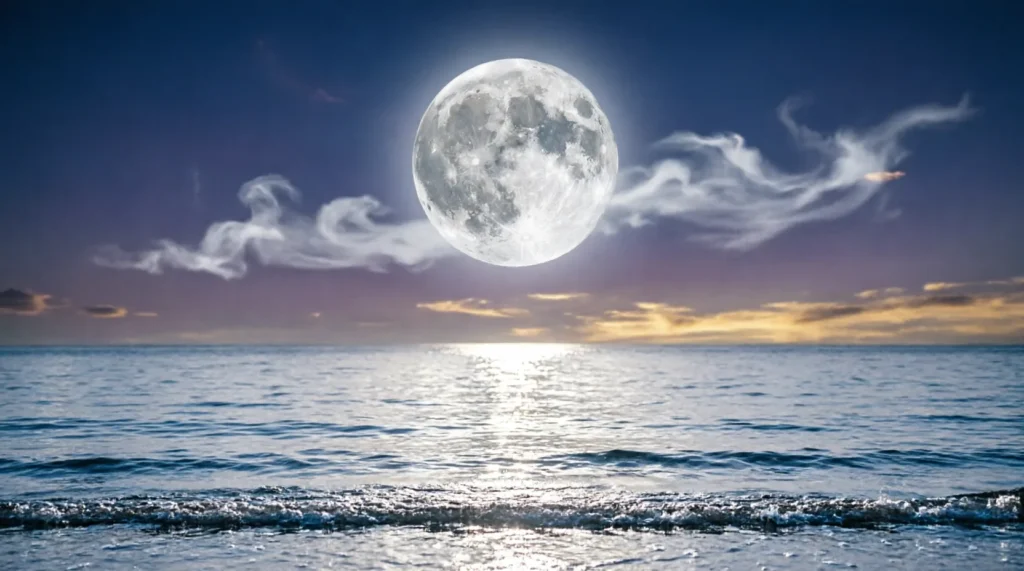
The moon is perhaps the most written-about object in human history, yet finding fresh language for it remains a challenge for writers at every level. When you search for good metaphors for the moon, you are looking for more than just decorative language; you are seeking a way to anchor your reader’s emotional experience in something tangible and resonant. The examples below are categorized by mood and function, giving you immediate, usable options for poetry, prose, and personal essays.
Understanding the Lunar Metaphor
Before diving into specific examples, it helps to understand why the moon lends itself so naturally to figurative language. A metaphor creates a direct identification between two unlike things, asserting that one thing is another to highlight a shared quality. According to Metaphor, this figure of speech allows writers to convey complex ideas and emotions by linking them to familiar physical experiences.
Unlike a simile, which uses “like” or “as” to compare, a metaphor collapses the distance between the subject and the image. When we say the moon is a “silver coin,” we are not suggesting it resembles one; we are asking the reader to see it as one, with all the associated connotations of value, coldness, and circular perfection. This immediacy makes metaphors particularly powerful for describing celestial bodies, which often feel distant and abstract.
The moon itself is Earth’s only natural satellite, a barren world of craters and dust that reflects sunlight rather than generating its own light. As detailed in Moon, its phases and gravitational pull have shaped human culture, mythology, and scientific understanding for millennia. This dual nature—both a physical rock and a cultural symbol—provides rich ground for metaphorical exploration.
The Moon as a Watchful Eye
One of the most enduring traditions in literature is personifying the moon as a conscious observer. These metaphors work well when your character feels exposed, judged, or comforted by the night sky.
“The moon was a pale eye blinking open in the dark.” — “He felt the weight of the gaze, as if the sky itself were judging his choices.” (unsettling, vigilant)
- Craft note: The verb “blinking” adds a biological, almost predatory quality to the celestial body, turning passive observation into active scrutiny.
“A cyclops’ eye, wide and unblinking, stared down from the zenith.” — “There was no place to hide under that singular, white glare.” (mythic, intense)
“The moon was a sentinel standing guard over the sleeping city.” — “Its presence promised safety, a silent vow that the night would pass without incident.” (protective, steady)
“A ghostly pupil dilated in the black iris of the sky.” — “The darkness around it seemed to deepen, pulling focus to that cold, white center.” (eerie, visual)
“The night’s watchman, hanging his lantern high above the fields.” — “Farmers checked its position to gauge the hours until dawn.” (rustic, functional)
“A silver iris reflecting the world’s secrets back at itself.” — “She whispered her truths to the moon, knowing it would keep them safe in its reflective surface.” (confessional, intimate)
“The sky’s single, sleepless eye.” — “Insomnia felt less lonely when she remembered the moon was awake too.” (comforting, companionable)
“A blind eye turned toward the chaos below.” — “The moon offered no judgment, only a blank, white indifference to human suffering.” (detached, nihilistic)
Avoid the cliché of the “man in the moon” unless you are writing for young children or aiming for deliberate whimsy. It lacks the emotional precision modern readers expect.
The Moon as Currency and Value
Metaphors linking the moon to money or valuable objects highlight its brightness, roundness, and perceived worth. These images work best in contexts involving loss, gain, or the commodification of beauty.
“The moon was a silver coin tossed into the well of night.” — “It sank slowly, rippling the darkness with its cold light.” (poetic, transient)
- Craft note: The image of a coin sinking suggests both value and loss, creating a bittersweet tone that resonates with themes of fleeting beauty.
“A polished doubloon nailed to the velvet ceiling.” — “Pirates of the imagination sailed beneath its golden glow.” (adventurous, rich)
“The sky’s spare change, scattered and bright.” — “When the full moon broke apart into clouds, it looked like loose silver spilling from a pocket.” (casual, abundant)
“A pearl dropped into ink.” — “The contrast was stark, a perfect sphere of purity against the void.” (classic, elegant)
“A minted disc of cold light.” — “It bore no face, only the smooth, impersonal shine of manufactured wealth.” (industrial, detached)
“A token paid to the night for its silence.” — “We accepted the moon’s light as compensation for the darkness it did not banish.” (philosophical, transactional)
“A gold sovereign stamped with the face of absence.” — “It bought us nothing but the ability to see what we had lost.” (melancholic, ironic)
Be cautious with “cheese” metaphors. While “the moon is made of green cheese” is a well-known proverb, using it in serious literary work undermines the gravity of your imagery. Reserve it for humor or satire.
The Moon as a Wound or Scar
For darker narratives, the moon can represent injury, incompleteness, or healing. These metaphors are particularly effective in gothic fiction, trauma narratives, or stories dealing with memory.
“The moon was a bandage wrapped tight around the night’s wound.” — “It held the darkness together, preventing it from bleeding out into the stars.” (healing, fragile)
- Craft note: This reverses the usual expectation of the moon as a source of light, framing it instead as a medical intervention against the “wound” of darkness.
“A white scar across the belly of the sky.” — “It reminded him of the accident, a permanent mark on an otherwise smooth expanse.” (traumatic, persistent)
“The crescent was a sickle cutting through the fabric of evening.” — “Each night it sliced away a little more of the day’s warmth.” (violent, seasonal)
“A blister of light on the skin of the world.” — “It pulsed with a feverish glow, promising rain before the storm broke.” (ominous, physical)
“A tear dried white on the cheek of night.” — “The sorrow had passed, but the stain remained.” (mournful, residual)
“A hole punched in the curtain of space.” — “Through it, the raw light of the universe leaked in, unfiltered and harsh.” (cosmic, exposing)
“The moon was a bone exposed after the flesh of dusk had rotted away.” — “Winter nights felt skeletal, stripped of their autumn softness.” (macabre, stark)
These images require careful handling. Ensure the surrounding text supports the visceral nature of the metaphor; otherwise, it may feel jarring rather than impactful.
The Moon as a Domestic Object
Bringing the moon down to earth through domestic metaphors creates intimacy and relatability. These comparisons work well in contemporary fiction, memoirs, or poems about home and family.
“The moon was a dinner plate left out on the porch.” — “It waited to be cleared away by the morning sun.” (mundane, temporary)
- Craft note: This demystifies the celestial, grounding the sublime in the everyday. It suggests that even the most majestic phenomena are part of our daily routine.
“A nightlight plugged into the socket of the horizon.” — “It cast long, familiar shadows across the nursery floor.” (comforting, childish)
“The moon was a lampshade tipped sideways.” — “It spilled its light unevenly, pooling in the corners of the yard.” (accidental, soft)
“A button undone on the coat of the sky.” — “Through the gap, the cold wind of space whistled through.” (structural, chilly)
“A mirror hung in the hallway of night.” — “It reflected only what we brought to it, offering no truth of its own.” (reflective, empty)
“The moon was a lid placed loosely on the pot of darkness.” — “Steam rose from the edges, blurring the stars.” (contained, humid)
“A clock face with no hands, marking time by its shape.” — “We knew the hour not by numbers, but by how much of the circle remained.” (temporal, intuitive)
Avoid overusing “lantern” or “lamp” without additional specificity. These are common tropes; adding a domestic context (like “nightlight” or “dinner plate”) refreshes the image.
How to Write Your Own Moon Metaphor
Creating original metaphors requires moving beyond the first idea that comes to mind. Here is a simple three-step process I use with my students to generate fresh lunar imagery.
- Identify the emotional core. Ask yourself: What does the moon feel like in this specific scene? Is it comforting, threatening, indifferent, or lonely? Do not start with the visual appearance; start with the emotion.
- Brainstorm concrete objects associated with that emotion. If the moon feels cold and valuable, think of silver, ice, or coins. If it feels watchful, think of eyes, cameras, or guards. List ten objects before selecting one.
- Test the fit. Replace “moon” with your chosen object in a sentence. Does it hold up? Does it create a new insight? If the connection feels forced, discard it and try the next object.
Worked Example:
- Emotion: Loneliness.
- Objects: Island, orphan, single sock, lighthouse, unused ticket.
- Selection: “Unused ticket.”
- Draft: “The moon was an unused ticket to a journey no one took.”
- Refinement: “The moon hung like an unused ticket, valid for a journey into the dark that no one dared to board.”
This method ensures your metaphors are driven by meaning rather than mere decoration.
Frequently Asked Questions
What is the difference between a metaphor and a simile for the moon? A metaphor states that the moon is something else (e.g., “The moon is a silver coin”), while a simile says it is like something else (e.g., “The moon is like a silver coin”). Metaphors are generally more direct and impactful, while similes allow for more nuance and comparison.
How do I avoid clichés when writing about the moon? Avoid overused images like “pearl,” “cheese,” or “man in the moon” unless you are subverting them intentionally. Instead, focus on specific, unexpected connections tied to the emotional context of your scene. Use the brainstorming method above to find fresh associations.
Can I mix metaphors for the moon in the same piece? Yes, but do so sparingly. Mixing too many different metaphorical frameworks (e.g., calling it a “coin” in one paragraph and an “eye” in the next) can confuse the reader. Stick to one dominant metaphorical thread per scene or chapter to maintain coherence.
Why are moon metaphors so common in poetry? The moon’s changing phases, its reflection of sunlight, and its constant presence in the night sky make it a versatile symbol for change, reflection, and consistency. Its physical distance also allows writers to project human emotions onto it without contradicting observable reality.

Richard Jackson is an expert in semantics and figurative language, with particular expertise in simile theory and practice. Holding a Ph.D. in Linguistics from Harvard University, where his thesis focused on simile and metaphor in modern literature, Richard has dedicated over 20 years to the study of figurative language. His journey into this field began with a fascination for how similes can unlock deeper meanings and create resonant storytelling moments. Richard’s work examines the cognitive processes behind simile construction and comprehension, offering insights into how these figures of speech influence reader perception. He has published numerous articles and book chapters, cementing his status as a thought leader in the linguistic community. At SimileStation, Richard writes about the psychological underpinnings of similes, comparative linguistic analyses, and offers tips for writers aiming to enhance their craft. His dedication to language is as deep as the ocean, continually exploring new depths in the world of figurative expression.