

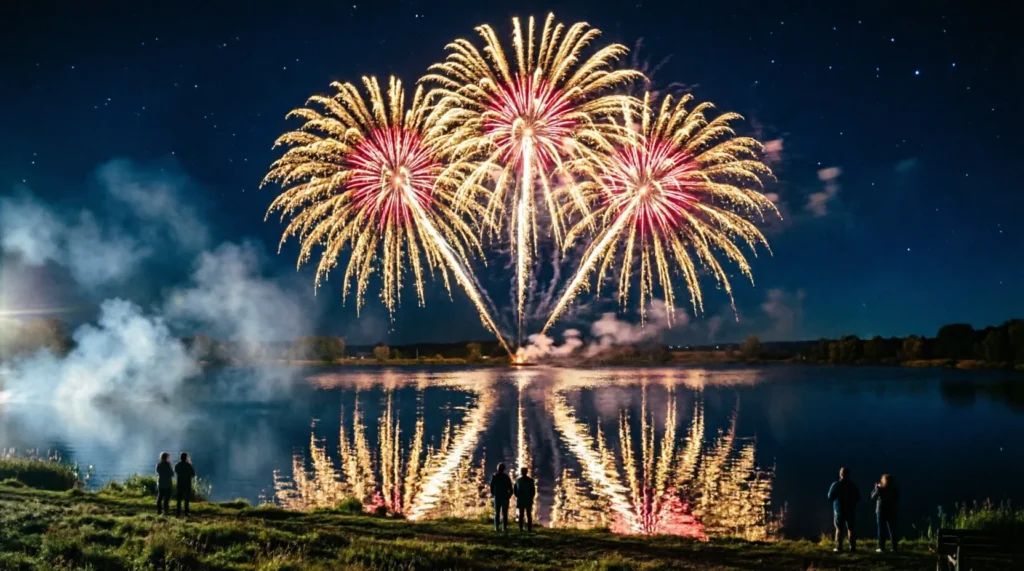
Similes for fireworks do one job: they hand your reader the light, the boom, and the gone-too-soon ache in a single line. Below you’ll find dozens of comparisons sorted by what they describe — brightness, sound, brevity, joy, and chaos — each one already wired into a sentence you can borrow or bend. Steal freely, then twist what you steal until it sounds like you.
Similes for the Light and Color of Fireworks
Light is where my students spend their whole first draft, and it’s where clichés breed fastest. The fix is to reach for objects closer to home than the sun. These are the comparisons that have survived my red pen.
-
“like a chandelier swung out over the night” — “The first shell opened like a chandelier swung out over the night, and every face in the park lifted at once.” (elegant, intimate). Craft note: choosing a household object over a cosmic one is what makes this land — the sky suddenly feels like a room we’re standing in.
-
“as bright as a photographer’s flash” — “For one heartbeat the harbor was as bright as a photographer’s flash, then the dark folded back in.” (crisp, modern).
-
“like spilled neon on black velvet” — “Red and green smoke trailed like spilled neon on black velvet.” (lush, poetic). Craft note: two textures colliding — wet light, soft dark — give the reader something tactile, not just visual.
-
“as colorful as a kicked-over crayon box” — “The finale scattered as colorful as a kicked-over crayon box, all at once and everywhere.” (playful, kid-friendly).
-
“like a sky full of shattered stars” — “By the last volley it was a sky full of shattered stars, drifting down over the outfield.” (awed, epic).
-
“as golden as honey poured over the dark” — “The willow shell drooped as golden as honey poured over the dark, slow enough to count.” (soft, lyrical). Craft note: the long, syrupy rhythm imitates the slow fall of a willow shell — the sound of the line doing the work of the sight.
-
“like a disco ball exploded in slow motion” — “My student called the burst ‘like a disco ball exploded in slow motion,’ and I made the whole class applaud.” (fun, irreverent).
The version my students always reach for first is “as bright as the sun,” and it’s the one I make them cross out first. It’s technically a simile, and it’s also technically asleep at the wheel.
Similes for the Sound of Fireworks
Half the show happens in the chest, not the eyes, yet sound similes are the most neglected paragraph in every draft I receive. Borrow one of these the next time you need the boom to carry the scene.
-
“as loud as cannon fire” — “The salute boomed as loud as cannon fire, and I felt each round in my sternum.” (intense, physical).
-
“like thunder that arrives on schedule” — “The mortars went off every thirty seconds, like thunder that arrives on schedule.” (wry, controlled). Craft note: thunder is the tired default for any loud sky; the phrase “on schedule” twists the cliché into something new and a little funny.
-
“as sharp as a cracking whip” — “The cracker shells snapped as sharp as a cracking whip, and the neighbor’s dog bolted for the porch.” (startling, tense).
-
“like popcorn popping in a giant’s kitchen” — “The little crackles at the end of each burst sounded like popcorn popping in a giant’s kitchen.” (cozy, humorous).
-
“as low and long as a freight train braking” — “The big shells thumped as low and long as a freight train braking two towns over.” (heavy, resonant).
-
“like a drumline warming up behind the clouds” — “Before the show officially started, the distant test shells rolled in like a drumline warming up behind the clouds.” (anticipatory, rhythmic).
-
“as sudden as a slammed door” — “Somewhere past the lake, a single report cracked as sudden as a slammed door.” (jarring, ominous).
Skip “like a bomb” unless your scene is actually about bombs. In a celebration piece it’s tonally clumsy, and in a war piece it’s redundant.
Similes for How Quickly Fireworks Fade
The ache of fireworks is their brevity, and this is the category that turns description into feeling. I’ve watched a college essay about a grandfather land entirely on one of these lines.
-
“as brief as a wish” — “Each bloom was as brief as a wish, gone before I could finish saying look.” (tender, wistful). Craft note: one syllable per key word keeps the line as quick as the light it describes — rhythm and subject in agreement.
-
“like a Polaroid developing in reverse” — “The pink glow faded like a Polaroid developing in reverse, giving the image back to the dark.” (nostalgic, modern).
-
“as quick to fade as a tan from August” — “The memory of the finale went as quick to fade as a tan from August.” (wry, specific).
-
“like laughter in the next room” — “The last glow dimmed like laughter in the next room — still lovely, already leaving.” (melancholy, quiet).
-
“as temporary as chalk art before rain” — “We stood there knowing it was as temporary as chalk art before rain, and loved it harder for that.” (poignant, grateful).
-
“like smoke writing erased by wind” — “The trails hung like smoke writing erased by wind before I finished reading them.” (contemplative, lyrical).
This is the strongest category on the page, in my honest opinion. “As brief as a wish” is the single simile here I wish I’d written.
Similes for the Joy and Celebration of Fireworks
Not every fireworks scene needs weight. Some need the reader to grin, and these do that work without turning saccharine.
-
“like applause written in light” — “The volley over the hospital felt like applause written in light for everyone who’d stayed up too late.” (warm, grateful). Craft note: it flips the usual direction — instead of us watching the sky, the sky is watching us, and that reversal is the whole trick.
-
“like confetti the sky threw for itself” — “On New Year’s the bursts went up like confetti the sky threw for itself.” (whimsical, joyful).
-
“as festive as a wedding toast” — “The finale was as festive as a wedding toast, all noise and warmth and strangers smiling at strangers.” (celebratory, communal).
-
“like the sky clearing its throat to sing” — “The first whistle rose like the sky clearing its throat to sing.” (playful, musical).
-
“as sweet as the last bite of birthday cake” — “The final golden willow was as sweet as the last bite of birthday cake, and just as gone too soon.” (cozy, nostalgic).
-
“like a standing ovation from the whole town” — “When the bridge lit up, the fireworks felt like a standing ovation from the whole town.” (triumphant, communal).
-
“as welcoming as a porch light left on” — “Grandpa handing out sparklers was as welcoming as a porch light left on.” (tender, familial).
Similes for the Chaos and Violence of Fireworks
Not every scene is a picnic blanket. War memoirs, thriller chapters, and anxious narrators need fireworks that threaten. According to Fireworks, gunpowder fireworks began in China and traveled west along the same routes that carried gunpowder into cannons and war — so reaching for battle imagery here isn’t a stretch, it’s a homecoming.
-
“like tracer rounds sewing the dark” — “From the rooftop the display looked like tracer rounds sewing the dark together.” (grim, cinematic).
-
“as ominous as a warning shot” — “The early single boom rolled across the water as ominous as a warning shot.” (tense, foreboding).
-
“like a battlefield photographed in color” — “The veteran beside me watched the red bursts in silence, like a battlefield photographed in color.” (somber, respectful).
-
“as wild as a bar fight in zero gravity” — “The roman candle exchange behind the gas station was as wild as a bar fight in zero gravity.” (humorous, chaotic).
-
“like dragons clearing their throats” — “The big mortars growled like dragons clearing their throats.” (mythic, powerful).
-
“as angry as an argument behind a closed door” — “The muffled booms through the apartment wall were as angry as an argument behind a closed door.” (uneasy, domestic).
-
“like the sky’s temper tantrum” — “My nephew narrated the crackle storm as the sky’s temper tantrum, and I wrote it down on the program.” (childlike, funny).
How to Write Your Own Fireworks Simile
According to Simile, a simile compares two unlike things with an explicit marker — “like” or “as” — which is exactly what separates it from a metaphor, where the comparison is asserted outright. That little marker is your friend: it gives you room to surprise the reader twice, once at the marker and once at the destination.
Here’s the three-step drill I give my students:
-
Pick one sense or one feeling, not the whole show. “The sound in my chest” beats “the fireworks.”
-
Reach outside the sky for the comparison. Kitchens, weddings, traffic, pets, arguments — the further the comparison lives from the sky, the bigger the surprise when it connects.
-
Say it out loud. If it’s a phrase you’ve heard before, cross it out and go one image stranger.
Worked example: start with the flat sentence “The finale was loud.” Step 1 narrows to the feeling — the boom in the chest — and step 2 reaches for home life instead of weather: a toolbox, a washing machine, a dad stomping downstairs.
Step 3 says it aloud and keeps the strangest true option: “The finale thumped through the bleachers like my dad’s toolbox falling down the stairs.” It’s specific, surprising, and true — the three things a good simile owes you.
Frequently Asked Questions
What are the most overused similes for fireworks? The tired three are “as bright as the sun,” “like a bomb,” and “lit up the sky like a Christmas tree.” Each one was fresh exactly once. If a comparison could appear on a grocery-store greeting card, push past it.
Should I use a simile or a metaphor for fireworks? Use a simile when you want the reader to notice the act of comparing — it slows the line down and suits narration and memoir. Use a metaphor when you want compression and punch, which suits poetry and song lyrics. Neither is stronger; they’re different gears.
Can similes for fireworks work in serious writing, like a college essay or a eulogy? Yes, if you borrow from the brevity and sound categories rather than the party ones. A line about light that refuses to stay does real emotional work in a memorial piece; the same line would flop in a hype post for a city show. Match the category to the occasion.
How many similes should I use in one paragraph? One per image, almost always. Stack three similes on a single burst and the reader stops seeing fireworks and starts seeing a thesaurus on fire. Spend your best comparison on the moment that matters most — usually the finale or the fade.

Richard Jackson is an expert in semantics and figurative language, with particular expertise in simile theory and practice. Holding a Ph.D. in Linguistics from Harvard University, where his thesis focused on simile and metaphor in modern literature, Richard has dedicated over 20 years to the study of figurative language. His journey into this field began with a fascination for how similes can unlock deeper meanings and create resonant storytelling moments. Richard’s work examines the cognitive processes behind simile construction and comprehension, offering insights into how these figures of speech influence reader perception. He has published numerous articles and book chapters, cementing his status as a thought leader in the linguistic community. At SimileStation, Richard writes about the psychological underpinnings of similes, comparative linguistic analyses, and offers tips for writers aiming to enhance their craft. His dedication to language is as deep as the ocean, continually exploring new depths in the world of figurative expression.