

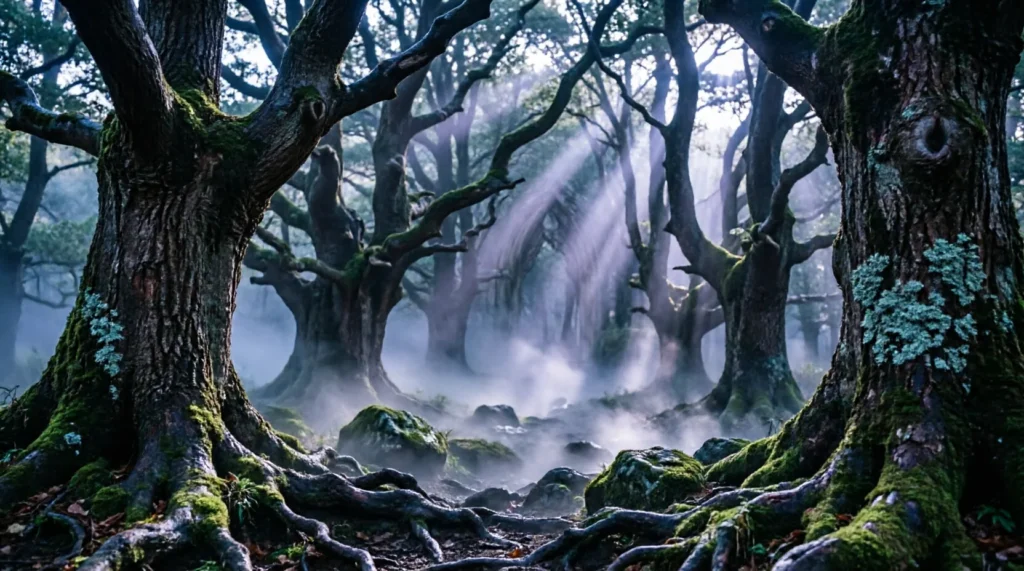
When you need to convey the unsettling atmosphere of a shadowed woodland, similes give readers an instant emotional anchor. The examples below are organized by mood and intensity so you can find the perfect comparison for your scene, whether you’re writing horror, fantasy, or literary fiction.
Ominous and Threatening
These similes emphasize danger and foreboding—the kind of darkness that feels actively hostile.
“like a predator’s open maw” — “The trail disappeared into the trees like a predator’s open maw.” (menacing, visceral)
“as suffocating as a burial shroud” — “The canopy pressed down as suffocating as a burial shroud.” (claustrophobic, funereal)
“like standing at the edge of a grave” — “Stepping into the clearing felt like standing at the edge of a grave.” (solemn, ominous)
“as impenetrable as a prison wall” — “The darkness stretched ahead as impenetrable as a prison wall.” (trapping, hopeless)
“like walking into a wolf’s den” — “She entered the grove like walking into a wolf’s den.” (dangerous, instinctive fear)
“as cold as a crypt at midnight” — “The air grew as cold as a crypt at midnight.” (deathly, chilling)
Craft note: “Like a predator’s open maw” works because it activates the reader’s primal fear response—the image is immediate and visceral without being overwrought. The alliteration of “predator’s” and “maw” also gives it a satisfying mouthfeel when read aloud.
Mysterious and Enigmatic
Use these when the forest’s darkness feels unknowable rather than purely threatening—when mystery outweighs menace.
“like an unsolved riddle” — “The path wound through shadows like an unsolved riddle.” (puzzling, intriguing)
“as unknowable as deep water” — “The forest floor vanished into undergrowth as unknowable as deep water.” (vast, uncertain)
“like a secret kept too long” — “The darkness between the pines hung heavy like a secret kept too long.” (weighted, intimate)
“as elusive as a half-remembered dream” — “The clearing appeared as elusive as a half-remembered dream.” (ephemeral, frustrating)
“like a locked door in an old house” — “The grove waited like a locked door in an old house.” (curious, anticipatory)
“as cryptic as ancient runes” — “The twisted branches formed patterns as cryptic as ancient runes.” (archaic, coded)
“like a whisper just below hearing” — “Movement in the understory was like a whisper just below hearing.” (subtle, unsettling)
According to Wikipedia’s entry on simile, these comparisons work by establishing a relationship of likeness that helps readers grasp abstract qualities through concrete imagery—which is exactly what you need when describing something as atmospheric as forest darkness.
Ancient and Timeless
These similes emphasize age, permanence, and the sense that the forest has existed long before humans and will remain long after.
“as old as forgotten gods” — “The oaks stood as old as forgotten gods.” (mythic, reverent)
“like a cathedral built by giants” — “The towering pines rose like a cathedral built by giants.” (awe-inspiring, sacred)
“as weathered as stone monuments” — “The bark was as weathered as stone monuments.” (enduring, scarred)
“like a memory the earth won’t release” — “The forest held the past like a memory the earth won’t release.” (haunting, persistent)
“as patient as mountains” — “The darkness waited as patient as mountains.” (immutable, indifferent)
“like a story written in a dead language” — “The grove felt like a story written in a dead language.” (inaccessible, archaic)
Avoid “as old as time itself”—it’s a tired cliché that has lost all impact through overuse. Your readers deserve fresher imagery.
Claustrophobic and Oppressive
When the forest feels like it’s closing in, these similes capture that suffocating pressure.
“like being swallowed whole” — “The trees closed behind us like being swallowed whole.” (consuming, inescapable)
“as tight as a clenched fist” — “The undergrowth pressed in as tight as a clenched fist.” (constricting, tense)
“like wearing a weighted blanket” — “The humidity hung on the air like wearing a weighted blanket.” (heavy, exhausting)
“as confining as a coffin” — “The space between trunks felt as confining as a coffin.” (deathly, trapped)
“like breathing through wet cloth” — “The air grew thick like breathing through wet cloth.” (labored, panicked)
“as pressing as a crowd” — “The darkness gathered as pressing as a crowd.” (overwhelming, invasive)
Craft note: “Like being swallowed whole” is the version my students always reach for first when describing encroaching forest darkness, and for good reason—it captures the active, predatory quality of the environment while maintaining a fairy-tale resonance that fits the genre perfectly.
Alive and Watching
These similes suggest the forest itself is conscious, observant, or even predatory.
“like a hundred unblinking eyes” — “Gaps in the canopy stared down like a hundred unblinking eyes.” (paranoid, observed)
“as watchful as a sentinel” — “The ancient yew stood as watchful as a sentinel.” (guarding, judgmental)
“like breath held too long” — “The stillness felt like breath held too long.” (tense, anticipatory)
“as aware as a stalking cat” — “The forest shifted as aware as a stalking cat.” (predatory, calculated)
“like a crowd holding its breath” — “The clearing waited like a crowd holding its breath.” (expectant, charged)
“as attentive as a predator” — “Every rustle seemed as attentive as a predator.” (hunting, dangerous)
The Wikipedia article on how to describe emphasizes that effective description engages multiple senses and creates emotional resonance—these similes achieve both by suggesting not just what the forest looks like, but how it makes the character feel.
How to write your own dark forest simile
Creating original similes for forest darkness doesn’t require genius—just a systematic approach.
Step 1: Identify the specific quality you want to emphasize. Is it the weight of the darkness? Its age? Its threat level? Its mystery?
Step 2: Brainstorm concrete images from unrelated domains that share that quality. If you’re describing oppressive darkness, think about physical sensations (tight clothing, heavy blankets) or emotional experiences (grief, guilt, secrets).
Step 3: Test the comparison by reading it aloud. Does it create an immediate image? Does it feel fresh, or does it sound like something you’ve heard before?
Worked example: Let’s say you want to describe how the forest darkness seems to absorb sound. You might think: what else absorbs sound? A recording studio. Thick carpet. Snow. Now test each: “The darkness absorbed sound like thick carpet” (too domestic), “The darkness absorbed sound like snow” (seasonally confusing), “The darkness absorbed sound like a recording studio” (too technical). Try a different angle: what absorbs things greedily? A sponge. A black hole. A vacuum. “The darkness absorbed sound like a black hole” (too sci-fi for most contexts). “The darkness absorbed sound like a sponge soaking up water” (getting warmer). Final version: “The darkness drank up every sound like dry earth soaking rain.”
Frequently Asked Questions
What’s the difference between a simile and a metaphor when describing a forest?
A simile explicitly states the comparison using “like” or “as” (“the forest was like a cathedral”), while a metaphor makes the comparison directly (“the forest was a cathedral”). Similes tend to feel more tentative and poetic; metaphors feel more confident and declarative.
How many similes should I use in a single scene?
Restraint is key. One or two well-chosen similes per scene will have more impact than a paragraph stuffed with comparisons. Think of similes as seasoning—too little and the writing is bland, too much and you’ve ruined the dish.
Can I mix positive and negative similes for the same forest?
Absolutely, and you should if it serves your narrative. A forest can be “as beautiful as a cathedral” and “as threatening as a predator’s den” in the same passage if your character experiences both awe and fear. This complexity makes the setting feel real.
Are there similes I should avoid entirely?
Yes. “Dark as night” is redundant when describing a dark forest. “Spooky as a haunted house” is too on-the-nose for most literary work. And anything involving “pitch black” has been overused to the point of meaninglessness. Push yourself toward more specific, unexpected comparisons.

Kenneth White is a seasoned linguist with over 15 years of experience in studying and teaching figurative language. He earned his Master’s degree in English Literature from Yale University, where he developed a deep interest in the art of similes and metaphors. His fascination with how similes enhance storytelling and evoke vivid imagery has been a guiding force throughout his career. Kenneth has conducted numerous workshops and seminars, educating students and fellow writers on effectively incorporating similes into their work. He has authored several papers detailing the evolution of simile usage across different literary periods. At SimileStation, Kenneth focuses on exploring the historical significance of similes and how they reflect cultural contexts. His articles dissect famous literary works, highlighting the creative use of figurative language to inspire emerging writers. Kenneth’s passion for language is as unwavering as a lighthouse in a storm, guiding readers through the complexities of simile construction and application.