

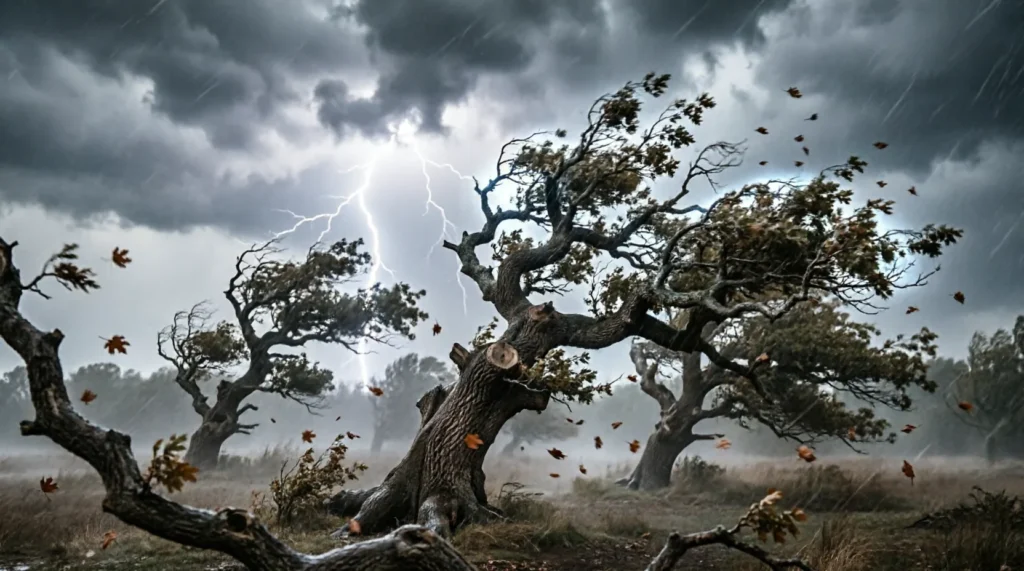
Similes for trees in a storm help you capture the raw power of nature and the resilience (or fragility) of what stands against it. The comparisons below are organized by mood and intensity so you can drop them straight into your scenes, poems, or essays without hunting for the right image.
Similes of Violent Motion and Chaos
When the wind hits hard, trees don’t just sway—they thrash, snap, and surrender to forces beyond their control. These similes capture that violent dance.
-
“like a drunkard stumbling in the dark” — “The oak reeled like a drunkard stumbling in the dark, branches clawing at empty air.” (disoriented, desperate; this one works because the alliteration of “drunkard” and “dark” mimics the stumbling rhythm)
-
“as frantic as a trapped animal” — “Pines whipped as frantic as a trapped animal, needles screaming through the gale.” (panicked, primal)
-
“like rag dolls in a child’s tantrum” — “Young saplings tossed like rag dolls in a child’s tantrum, roots barely holding the earth.” (helpless, violent)
-
“as wild as hair in a hurricane” — “The willow’s branches flew as wild as hair in a hurricane, a green storm within the storm.” (chaotic, untamed)
-
“like flags surrendering to conquest” — “Every branch bent like flags surrendering to conquest, bowing to the wind’s demands.” (defeated, forced submission)
-
“as frenzied as a conductor’s baton” — “The birch swayed as frenzied as a conductor’s baton, orchestrating chaos across the forest floor.” (controlled madness; I love the irony here—conductors create order, but this simile flips it)
-
“like a ship’s mast in a typhoon” — “The ancient cedar groaned like a ship’s mast in a typhoon, threatening to snap with each gust.” (maritime danger, structural stress)
-
“as reckless as a gambler doubling down” — “Branches cracked as reckless as a gambler doubling down, betting everything against the wind.” (risky, doomed)
the forces acting on a tree during a storm can exceed several tons of pressure, which explains why even the sturdiest specimens can appear so vulnerable when the gale hits.
Similes of Strength and Resistance
Not all trees break. Some stand firm, and these similes celebrate that stubborn defiance against impossible odds.
-
“like a sentinel refusing to kneel” — “The old maple stood like a sentinel refusing to kneel, roots gripping the earth like fists.” (noble, unwavering; this is my students’ favorite for heroic moments because “sentinel” carries military weight without being cliché)
-
“as unyielding as a fortress wall” — “Cypress trunks held as unyielding as a fortress wall, deflecting the wind’s assault.” (impenetrable, ancient strength)
-
“like an anchor in a rising sea” — “The redwood remained like an anchor in a rising sea, immovable despite the chaos above.” (grounded, stabilizing)
-
“as steadfast as a monk in prayer” — “Pines stood as steadfast as a monk in prayer, unmoved by the tempest’s fury.” (spiritual, meditative resistance)
-
“like a spine that will not break” — “The oak’s trunk held like a spine that will not break, bearing the weight of the storm.” (bodily, visceral; the anatomical comparison makes the tree feel alive in a way “strong as steel” never could)
-
“as resolute as a judge’s gavel” — “Branches bent but did not yield, as resolute as a judge’s gavel.” (authoritative, final)
-
“like a mountain wearing down the wind” — “The grove stood like a mountain wearing down the wind, patient and inevitable.” (geological, timeless; this flips the script—the tree isn’t resisting, it’s outlasting)
-
“as immovable as a tombstone” — “The cypress remained as immovable as a tombstone, marking the spot where the storm would fail.” (somber, permanent) For more, see Simile.
Similes of Fragility and Breaking Point
Sometimes the tree loses. These comparisons capture that moment of surrender, the crack, the fall.
-
“like a matchstick in a bonfire” — “The young ash snapped like a matchstick in a bonfire, consumed by forces it couldn’t fight.” (insignificant, doomed; the size contrast here is brutal and effective)
-
“as brittle as old bone” — “Deadwood cracked as brittle as old bone, splintering under the wind’s grip.” (aged, fragile)
-
“like glass under a hammer” — “The pine shattered like glass under a hammer, a thousand shards raining down.” (sudden, catastrophic)
-
“as weak as a child’s promise” — “The sapling bent as weak as a child’s promise, breaking before the storm even peaked.” (disappointing, unreliable)
-
“like a thread pulled too tight” — “Branches snapped like a thread pulled too tight, the tension finally too much to bear.” (inevitable, strained)
-
“as fragile as a moth’s wing” — “New growth tore as fragile as a moth’s wing, delicate against the gale’s brutality.” (ephemeral, beautiful destruction)
-
“like a house of cards in a draft” — “The weakened elm collapsed like a house of cards in a draft, structure failing all at once.” (precarious, total collapse; this is overused in business writing, but in nature scenes it still lands)
-
“as doomed as Icarus near the sun” — “The tree reached too high, as doomed as Icarus near the sun, and paid the price.” (mythic, tragic overreach)
Similes of Sound and Voice
Storms aren’t just visual—they’re deafening. These similes capture what trees sound like when the wind takes hold.
-
“like a choir of screaming violins” — “The forest howled like a choir of screaming violins, each branch a bow dragged too hard across strings.” (musical, painful; the synesthesia of sight and sound makes this visceral)
-
“as loud as a collapsing building” — “Timber cracked as loud as a collapsing building, announcing its own death.” (catastrophic, final)
-
“like a thousand pages turning at once” — “Leaves rustled like a thousand pages turning at once, the forest rewriting itself in the wind.” (literary, chaotic knowledge)
-
“as mournful as a widow’s wail” — “The cypress groaned as mournful as a widow’s wail, lamenting what the storm would take.” (grief-stricken, human)
-
“like drums in a war march” — “Branches pounded like drums in a war march, beating time for the storm’s advance.” (militant, rhythmic threat)
-
“as sharp as breaking crystal” — “Twigs snapped as sharp as breaking crystal, a thousand tiny deaths in the gale.” (precise, musical destruction)
-
“like a beast roaring in its den” — “The hollow trunk howled like a beast roaring in its den, wind echoing through empty space.” (primal, trapped fury)
Research on storm wind loads shows that the sound you hear isn’t just wind—it’s the tree’s structure responding to pressure, flexing and creaking as it redistributes forces through its root system and trunk.
Similes of Movement and Dance
There’s a terrible beauty in how trees move during storms. These comparisons capture that twisted choreography.
-
“like a dancer possessed by madness” — “The willow spun like a dancer possessed by madness, green skirts whipping in circles.” (uncontrolled, hypnotic)
-
“as fluid as ink in water” — “Branches swayed as fluid as ink in water, dissolving into the storm’s current.” (graceful, surrendering)
-
“like a pendulum counting down” — “The pine swung like a pendulum counting down, each arc bringing it closer to breaking.” (mechanical, inevitable)
-
“as rhythmic as a heartbeat racing” — “Trunks bent as rhythmic as a heartbeat racing, pulse quickening with each gust.” (bodily, anxious) For more, see Tree.
-
“like a flagpole in a gale” — “The young oak whipped like a flagpole in a gale, rigid at the base but wild at the top.” (structural, divided)
-
“as unpredictable as a coin toss” — “Branches jerked as unpredictable as a coin toss, never settling on which way to fall.” (random, anxious)
-
“like a metronome set too fast” — “The aspen trembled like a metronome set too fast, keeping time with a song no one could hear.” (mechanical, frantic)
Similes of Aftermath and Survival
The storm passes. These similes capture what remains—broken, bent, or miraculously whole.
-
“like a veteran bearing scars” — “The oak stood like a veteran bearing scars, branches missing but trunk unbroken.” (battle-worn, proud; this is the simile I reach for when writing about resilience because it honors the damage without romanticizing it)
-
“as stripped as a skeleton” — “The forest looked as stripped as a skeleton, leaves gone, only bones remaining.” (exposed, deathly)
-
“like a phoenix rising from ash” — “New shoots emerged like a phoenix rising from ash, the storm’s destruction feeding new life.” (mythic, regenerative)
-
“as humbled as a king dethroned” — “The mighty cedar lay as humbled as a king dethroned, crown broken on the forest floor.” (fallen power, tragic)
-
“like a survivor telling their story” — “The bent birch stood like a survivor telling their story, twisted but still standing.” (testimony, endurance)
-
“as changed as a face after grief” — “The grove looked as changed as a face after grief, familiar but forever altered.” (emotional, permanent transformation)
-
“like a lesson learned too late” — “Splintered trunks lay like a lesson learned too late, the storm’s final argument.” (regretful, instructive)
How to write your own trees in a storm simile
Creating fresh similes for trees in a storm requires you to focus on one specific aspect of the scene—the sound, the movement, the emotional weight—rather than trying to capture everything at once.
Step 1: Identify what the tree is doing (thrashing, holding, breaking, singing) and what emotion that action carries (fear, defiance, grief, joy).
Step 2: Find an unexpected comparison from a different domain (music, warfare, anatomy, mythology) that shares that same action and emotion.
Step 3: Test it aloud—if it sounds clunky or predictable, push further.
Worked example: Instead of “the tree bent like a bow” (overused, predictable), I asked: what does bending under pressure feel like? It feels like holding your breath before bad news. So: “The tree held its breath like a child waiting for bad news, branches frozen mid-sway.” That’s fresher because it connects physical movement to emotional suspension.
Frequently Asked Questions
What makes a good simile for trees in a storm? A strong simile captures both the physical action and the emotional weight of the moment. Avoid generic comparisons like “strong as an oak” (which is itself a cliché) and instead focus on specific details—the sound of splintering wood, the rhythm of swaying branches, or the aftermath of broken limbs.
Should I use similes for trees in a storm in formal writing? Yes, but sparingly. In academic or technical writing, one well-placed simile can illuminate a concept (like comparing structural stress to a familiar experience). In creative nonfiction or essays, they’re essential for bringing scenes to life. Just don’t stack multiple similes in one paragraph—that overwhelms the reader.
How do I avoid clichés when writing tree similes? Skip anything involving “strong as an oak,” “bent like a willow,” or “falling like timber.” These are dead from overuse. Instead, pull comparisons from unexpected domains—technology, medicine, music, or personal experience. The goal is surprise, not familiarity.
Can I mix positive and negative similes in the same piece? Absolutely. Storms are complex—they destroy and renew, terrify and exhilarate. Mixing similes of fragility with similes of strength creates tension and reflects the reality that nature is neither purely benevolent nor purely cruel. Just make sure the shift in tone serves your larger purpose.

Melissa Harris combines her background in creative writing with a keen analytical mind to bring a unique perspective on similes and figurative language. She holds a Bachelor of Arts in Creative Writing from the University of Iowa and a Ph.D. in Comparative Literature from Stanford University. Her love for the lyrical and the whimsical aspects of language drew her to specialize in figurative speeches, such as similes. With over a decade of experience as a writer and editor, Melissa is adept at breaking down complex figurative constructs into digestible insights for her audience. She is especially interested in the cognitive impact of similes in poetry and prose and enjoys experimenting with innovative approaches to simile creation in her writing. At SimileStation, Melissa contributes in-depth analysis pieces and creative exercises designed to spark imagination and refine readers’ use of similes. Her work inspires others to view language as an ever-evolving canvas, where words create a vivid tapestry of expression.