

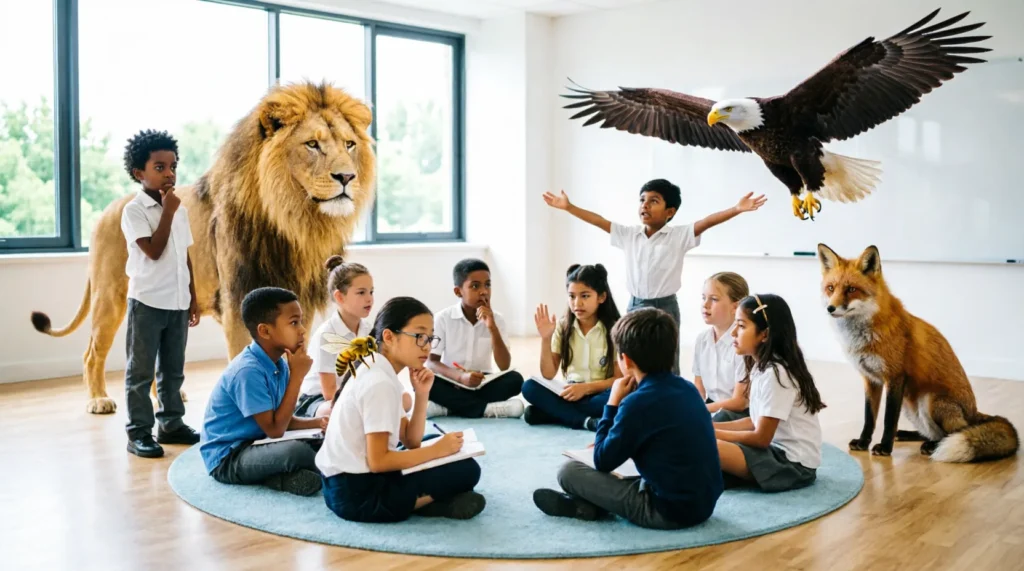
Similes give fifth graders a powerful shortcut to vivid description, letting them compare one thing to another using “like” or “as” to make their writing pop. The list below organizes similes by theme so students can quickly find the right comparison for people, nature, emotions, action, and everyday school life. Each example comes in a real sentence so your students can see exactly how to drop it into their own stories and essays.
Similes for Describing People and Character
Fifth graders are constantly observing the people around them—their friends, teachers, family members, and classmates. These similes help them capture personality traits and physical descriptions with more flair than basic adjectives.
- “as busy as a bee” — “My mom was as busy as a bee, rushing from the kitchen to the laundry room without stopping.” (energetic, admiring)
- “as brave as a lion” — “Even though he was nervous, Marcus stood up to present his project as brave as a lion.” (confident, heroic) This one works because lions carry instant cultural weight as symbols of courage—your students feel that resonance immediately.
- “as quiet as a mouse” — “During the test, the classroom was as quiet as a mouse.” (peaceful, focused)
- “as stubborn as a mule” — “My little brother refused to clean his room and was as stubborn as a mule.” (frustrated, humorous) I tell my students this simile has survived for centuries because everyone knows a mule won’t budge—it’s specific and universally understood.
- “as wise as an owl” — “My grandmother always gives the best advice and is as wise as an owl.” (respectful, warm)
- “as strong as an ox” — “The football player lifted the heavy box as strong as an ox.” (impressive, physical)
- “as gentle as a lamb” — “Even though she’s tall, Ms. Garcia is as gentle as a lamb when helping struggling readers.” (kind, reassuring)
- “as sly as a fox” — “The detective in the story was as sly as a fox, always one step ahead of the villain.” (clever, admiring)
Avoid “as cool as a cucumber”—it’s so overused that it’s lost its punch. Push students toward fresher comparisons instead.
Similes for Nature and Weather
Nature similes are fifth-grade gold because kids experience weather and the outdoors daily. These comparisons help them describe settings in their narratives with sensory detail that transports readers.
- “as cold as ice” — “The wind blew through the open window and the room became as cold as ice.” (uncomfortable, sharp)
- “as hot as an oven” — “We stepped outside and the parking lot was as hot as an oven.” (intense, oppressive)
- “as clear as crystal” — “The mountain lake was as clear as crystal, and we could see every rock on the bottom.” (pure, beautiful)
- “as dark as night” — “When the power went out, the basement was as dark as night.” (scary, disorienting)
- “as bright as the sun” — “Her smile was as bright as the sun and lit up the whole classroom.” (joyful, radiant) This simile succeeds because it pairs a concrete image (the sun) with an emotional effect (lighting up a space), giving students a model for layered description.
- “as steady as a rock” — “The old oak tree stood in the storm as steady as a rock.” (reliable, enduring)
- “as light as a feather” — “The dandelion seed floated away as light as a feather.” (delicate, airy)
- “as heavy as lead” — “After running five miles, my legs felt as heavy as lead.” (exhausted, weighted)
- “as fresh as a daisy” — “After a good night’s sleep, I woke up feeling as fresh as a daisy.” (refreshed, cheerful)
Similes for Emotions and Feelings
Fifth graders experience big emotions but often lack the vocabulary to express them precisely. These similes give them concrete images to match their internal experiences, which is crucial for both narrative writing and personal essays.
- “as happy as a clam” — “When the teacher announced no homework, we were as happy as clams.” (delighted, carefree)
- “as sad as a rainy day” — “After losing the game, she walked home as sad as a rainy day.” (melancholy, heavy)
- “as angry as a hornet” — “When someone took his seat, Jake was as angry as a hornet.” (furious, volatile)
- “as nervous as a long-tailed cat in a room full of rocking chairs” — “Before my piano recital, I was as nervous as a long-tailed cat in a room full of rocking chairs.” (extremely anxious, humorous) This extended simile is a favorite in my classroom because it’s funny and visual—students remember it and actually use it.
- “as excited as a kid on Christmas morning” — “When the field trip was announced, we were as excited as kids on Christmas morning.” (eager, bubbling)
- “as calm as a still pond” — “Even during the fire drill, our teacher remained as calm as a still pond.” (composed, peaceful)
- “as embarrassed as a tomato” — “When I tripped in the cafeteria, I turned as red as a tomato.” (mortified, blushing)
- “as proud as a peacock” — “After winning the science fair, she walked around as proud as a peacock.” (triumphant, showy)
Similes for Action and Movement
Action similes bring scenes to life. Whether students are writing adventure stories, sports narratives, or just describing what happened at recess, these comparisons add energy and specificity to movement. For more, see Simile.
- “as fast as lightning” — “The runner sprinted down the track as fast as lightning.” (speedy, explosive)
- “as slow as a snail” — “The line at lunch moved as slow as a snail.” (sluggish, frustrating)
- “as quick as a whip” — “The goalkeeper reacted as quick as a whip and blocked the shot.” (alert, responsive)
- “as graceful as a swan” — “The dancer moved across the stage as graceful as a swan.” (elegant, fluid)
- “as clumsy as a baby giraffe” — “I tried to carry all the books at once and was as clumsy as a baby giraffe.” (awkward, stumbling)
- “as smooth as silk” — “Her handwriting was as smooth as silk, with perfect loops on every letter.” (polished, refined)
- “as rough as sandpaper” — “The old wooden bench felt as rough as sandpaper against my legs.” (coarse, uncomfortable)
- “as sharp as a tack” — “Even though the puzzle was hard, Maya solved it as sharp as a tack.” (intelligent, quick-thinking)
Similes for School and Learning
These similes speak directly to the fifth-grade experience. They’re perfect for personal narratives about school challenges, persuasive essays about education, or just adding relatable detail to any classroom scene.
- “as easy as ABC” — “After studying all week, the spelling test was as easy as ABC.” (simple, confident)
- “as hard as rocket science” — “The math problem looked as hard as rocket science, but I figured it out.” (challenging, intimidating)
- “as clear as day” — “Once the teacher explained it again, the answer was as clear as day.” (obvious, understandable)
- “as boring as watching paint dry” — “The lecture about cafeteria rules was as boring as watching paint dry.” (dull, tedious)
- “as interesting as a book you can’t put down” — “The history project turned out to be as interesting as a book you can’t put down.” (engaging, captivating)
- “as confusing as a maze” — “The new school layout was as confusing as a maze until I found my classroom.” (disorienting, complex)
- “as rewarding as solving a puzzle” — “Finishing my chapter book felt as rewarding as solving a puzzle.” (satisfying, accomplished)
How to Write Your Own Grade 5 Simile
Creating original similes is a skill fifth graders can master with practice. Here’s my three-step process that I use in writing workshops:
Step 1: Identify the quality you want to highlight. Is your character fast? Sad? Strong? Name it clearly.
Step 2: Brainstorm objects, animals, or phenomena that share that quality. Don’t go with the first thing that comes to mind—push for the third or fourth option for freshness.
Step 3: Connect them with “like” or “as” and test it in a sentence. Does it make sense? Is it vivid?
Worked example: Let’s say you want to describe how quickly someone eats lunch. The quality is speed. First thought: “as fast as a cheetah.” Too common. Second thought: “as fast as a race car.” Better, but still predictable. Third thought: “as fast as a vacuum cleaner sucking up crumbs.” Now we’re getting somewhere—it’s specific, visual, and slightly humorous. Drop it in: “Jake finished his sandwich as fast as a vacuum cleaner sucking up crumbs.” That’s a simile your readers will remember. For more, see Grade.
Frequently Asked Questions
What’s the difference between a simile and a metaphor for fifth graders? A simile uses “like” or “as” to make a comparison (“her smile was like sunshine”), while a metaphor states that one thing IS another thing (“her smile was sunshine”). Similes are generally easier for fifth graders to grasp because the comparison word signals what’s happening.
How many similes should a fifth grader use in one piece of writing? Quality beats quantity every time. I tell my students to aim for 2-3 strong, well-placed similes in a narrative rather than stuffing every sentence with comparisons. Too many similes make writing feel forced and distract from the story.
Are there similes fifth graders should avoid? Yes—clichés like “as cool as a cucumber,” “as busy as a bee” (though this one still works in context), and “as pretty as a picture” have been used so much they’ve lost impact. Encourage students to twist familiar similes or create new ones instead.
Can similes be negative or should they only be positive? Similes can absolutely be negative! Describing something as “as smelly as old cheese” or “as annoying as a mosquito” creates vivid imagery just as effectively as positive comparisons. The key is matching the simile’s tone to what you’re trying to convey.

Melissa Harris combines her background in creative writing with a keen analytical mind to bring a unique perspective on similes and figurative language. She holds a Bachelor of Arts in Creative Writing from the University of Iowa and a Ph.D. in Comparative Literature from Stanford University. Her love for the lyrical and the whimsical aspects of language drew her to specialize in figurative speeches, such as similes. With over a decade of experience as a writer and editor, Melissa is adept at breaking down complex figurative constructs into digestible insights for her audience. She is especially interested in the cognitive impact of similes in poetry and prose and enjoys experimenting with innovative approaches to simile creation in her writing. At SimileStation, Melissa contributes in-depth analysis pieces and creative exercises designed to spark imagination and refine readers’ use of similes. Her work inspires others to view language as an ever-evolving canvas, where words create a vivid tapestry of expression.