

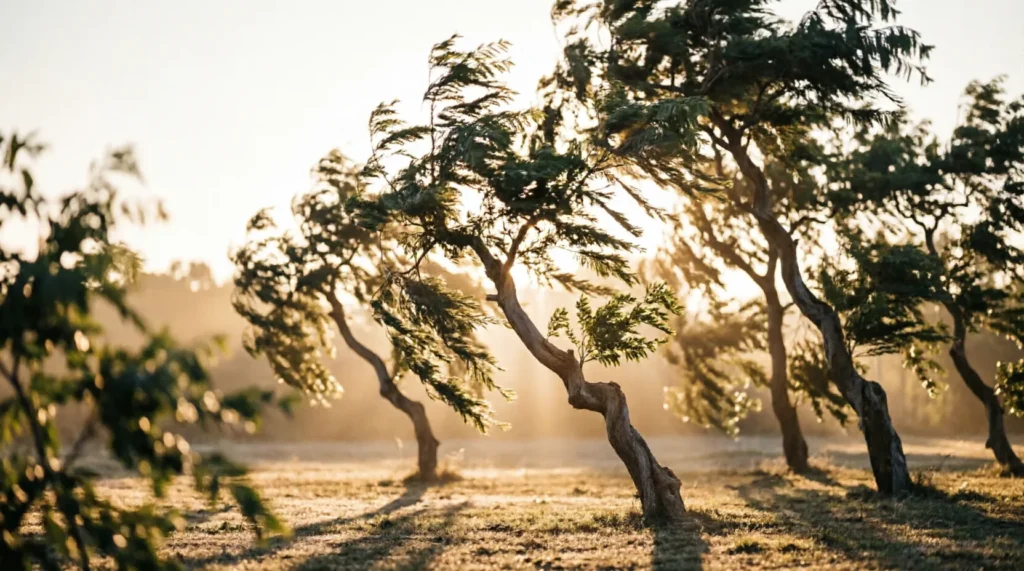
Finding the perfect simile for trees swaying in the wind transforms a flat landscape description into a living, breathing scene. According to the foundational definition of a simile, this figure of speech explicitly compares two different things using “like” or “as,” making it the ideal tool for anchoring abstract natural movements to concrete, relatable imagery. The examples below will give you ready-to-use, vivid comparisons categorized by mood and intensity, complete with example sentences and craft notes so you can drop them straight into your manuscript.
Gentle and Peaceful Similes
Before we categorize these comparisons, it helps to remember that swaying is fundamentally a rhythmic, oscillating motion. This physical reality means the most effective similes tap into a predictable, pendulum-like cadence rather than chaotic, random movement.
- “like a slow, breathing chest” — “The pine forest expanded and contracted like a slow, breathing chest beneath the midnight moon.” (calm, rhythmic)
- “as graceful as a ballet dancer’s final bow” — “The birch trees bent as graceful as a ballet dancer’s final bow when the evening breeze rolled through.” (elegant, serene)
- “like a mother rocking a cradle” — “The branches rocked back and forth like a mother rocking a cradle, lulling the valley to sleep.” (nurturing, soothing)
- “as fluid as silk slipping through fingers” — “The willow’s leaves moved as fluid as silk slipping through fingers in the light spring zephyr.” (soft, tactile)
- “like a quiet conversation between old friends” — “The aspens whispered and leaned toward each other like a quiet conversation between old friends.” (intimate, gentle)
- “as steady as a grandfather clock’s pendulum” — “The tall cedars swung as steady as a grandfather clock’s pendulum, marking the passage of the afternoon.” (reliable, measured) (Craft note: The hard ‘c’ and ‘k’ sounds in ‘clock’ and ‘marking’ mimic mechanical ticking, grounding the visual in auditory reality.)
- “like a ship gliding on a calm sea” — “The canopy rocked like a ship gliding on a calm sea, unhurried and completely at peace.” (tranquil, drifting)
- “as delicate as a sigh” — “The young saplings trembled as delicate as a sigh when the faintest draft touched their leaves.” (fragile, subtle)
Violent and Stormy Similes
- “like a frantic animal trapped in a cage” — “The oak branches thrashed like a frantic animal trapped in a cage as the hurricane winds tore through the yard.” (panicked, violent)
- “as aggressive as a whip cracking in the dark” — “The thin branches snapped and curled as aggressive as a whip cracking in the dark during the thunderstorm.” (harsh, dangerous)
- “like a drowning man reaching for the surface” — “The twisted limbs flailed like a drowning man reaching for the surface against the gale-force gusts.” (desperate, chaotic) (Craft note: The visceral imagery of a “drowning man” immediately raises the stakes, transforming a weather event into a life-or-death struggle.)
- “as relentless as a marching army” — “The forest bowed and surged as relentless as a marching army under the assault of the nor’easter.” (overwhelming, powerful)
- “like a ragdoll tossed by an angry child” — “The slender poplars were thrown about like a ragdoll tossed by an angry child, completely at the mercy of the squall.” (helpless, turbulent)
- “as violent as a fist pounding on a door” — “The wind hammered the trunks as violent as a fist pounding on a door, demanding entry to the cabin.” (aggressive, loud)
- “like a ship caught in a rogue wave” — “The ancient redwoods heaved like a ship caught in a rogue wave, groaning under the sheer weight of the storm.” (massive, strained)
- “as chaotic as a flock of startled crows” — “The treetops erupted as chaotic as a flock of startled crows, scattering leaves in every direction at once.” (disordered, explosive)
Melancholic and Lonely Similes
- “like a widow waving goodbye at a train station” — “The lone elm swayed like a widow waving goodbye at a train station, holding onto a memory that had already left.” (sorrowful, lingering)
- “as tired as an old man’s trembling hands” — “The bare branches shook as tired as an old man’s trembling hands in the cold autumn draft.” (weary, fragile)
- “like a ghost trying to remember its name” — “The mist-shrouded pines drifted like a ghost trying to remember its name, lost in the foggy hollow.” (eerie, forgotten)
- “as hollow as an abandoned house” — “The wind whistled through the canopy, making the trees sway as hollow as an abandoned house on a dead-end street.” (empty, desolate)
- “like a forgotten flag on a rusted pole” — “The solitary oak flapped its remaining leaves like a forgotten flag on a rusted pole, long after the battle was over.” (defeated, isolated)
- “as mournful as a cello’s lowest string” — “The forest groaned and bent as mournful as a cello’s lowest string played in an empty concert hall.” (deeply sad, resonant) (Craft note: Linking the deep, resonant groan of wood under stress to a cello’s low register creates an immediate, somber auditory association for the reader.)
- “like a sleeper trapped in a nightmare” — “The branches twitched and shuddered like a sleeper trapped in a nightmare, unable to wake from the winter chill.” (uneasy, trapped)
- “as resigned as a prisoner accepting their sentence” — “The willow drooped and swung as resigned as a prisoner accepting their sentence, offering no resistance to the gale.” (defeated, passive)
Joyful and Energetic Similes
- “like children chasing each other in a sprinkler” — “The young maples danced and bounced like children chasing each other in a sprinkler on a hot July afternoon.” (playful, exuberant)
- “as lively as a fiddle at a country dance” — “The aspen leaves shimmered and shook as lively as a fiddle at a country dance, full of bright, infectious energy.” (vibrant, musical) (Craft note: Comparing the visual shimmer of aspen leaves to the auditory bounce of a fiddle creates a synesthetic effect that makes the scene pop.)
- “like a dog greeting its owner at the door” — “The branches wagged and rustled like a dog greeting its owner at the door, thrilled by the sudden summer breeze.” (welcoming, happy)
- “as buoyant as a cork in fresh water” — “The canopy bobbed as buoyant as a cork in fresh water, riding the invisible waves of the spring wind.” (light, uplifting)
- “like a crowd cheering at a home run” — “The entire grove erupted and swayed like a crowd cheering at a home run, a unified wave of green celebration.” (triumphant, collective)
- “as spirited as a galloping horse” — “The forest moved as spirited as a galloping horse, its mane of leaves flying freely in the open meadow.” (wild, free)
- “like a jazz musician improvising a solo” — “The branches twisted and turned like a jazz musician improvising a solo, finding unexpected joy in every gust.” (creative, spontaneous)
- “as bright as a sparkler on the Fourth of July” — “The sunlit leaves flashed and trembled as bright as a sparkler on the Fourth of July, full of crackling life.” (festive, dazzling)
Mysterious and Eerie Similes
- “like skeletal fingers reaching from a grave” — “The dead branches clawed at the sky like skeletal fingers reaching from a grave, swaying in the foggy midnight air.” (macabre, haunting)
- “as secretive as a whispered conspiracy” — “The pines leaned together and rustled as secretive as a whispered conspiracy, hiding something in the deep woods.” (suspicious, hidden)
- “like a pendulum counting down to doom” — “The lone cypress swung back and forth like a pendulum counting down to doom, ticking away the final moments of daylight.” (ominous, inevitable)
- “as unsettling as a stranger staring through a window” — “The trees shifted in the peripheral vision as unsettling as a stranger staring through a window, always moving just out of focus.” (creepy, watchful)
- “like a phantom ship sailing through the mist” — “The canopy rolled like a phantom ship sailing through the mist, visible one second and swallowed by fog the next.” (ethereal, ghostly)
- “as cryptic as an ancient rune” — “The twisted oaks bent as cryptic as an ancient rune, their movements spelling out a warning no one could read.” (puzzling, foreboding)
- “like a predator stalking its prey in the tall grass” — “The underbrush and lower branches swayed like a predator stalking its prey in the tall grass, silent and deliberate.” (threatening, stealthy)
- “as disorienting as a fever dream” — “The forest warped and bent as disorienting as a fever dream, making it impossible to tell which way was north.” (confusing, surreal)
How to write your own trees swaying in the wind simile
Writing a memorable simile requires moving past the first idea that comes to mind. The version my students always reach for first is “like a dancer,” which is tired and overused. Skip it. Instead, follow these three steps to craft something original.
Step 1: Isolate the specific motion. Is the tree thrashing, bobbing, trembling, or groaning? A weeping willow moves entirely differently than a rigid pine.
Step 2: Anchor the motion to a human or mechanical experience. Think about rhythms you know: a rocking chair, a metronome, a shivering dog, or a waving crowd.
Step 3: Add a sensory detail beyond just sight. Bring in sound, temperature, or texture to ground the comparison.
Worked Example: Instead of “the trees moved like dancers in the wind,” try identifying the sound and the specific tree. “The dry bamboo stalks clattered together like a bundle of wooden wind chimes forgotten on a porch.” (Craft note: This works because it replaces a vague visual with a sharp, specific auditory memory that the reader can instantly hear.)
Frequently Asked Questions
What is the difference between a simile and a metaphor for trees in the wind? A simile explicitly uses “like” or “as” to make the comparison (e.g., “the trees swayed like a ship”), while a metaphor states the comparison directly as fact (e.g., “the trees were a green ocean”). Similes are often better for descriptive passages because they maintain a slight distance, allowing the reader to appreciate the comparison without feeling forced.
Why do writers use similes for nature scenes? By linking a tree’s movement to a familiar human experience, a writer bridges the gap between the vast, impersonal natural world and the reader’s intimate emotional reality. It turns a generic weather report into a moment of shared human recognition.
How can I avoid cliché similes when describing wind and trees? Avoid comparing trees to dancers, oceans, or waves unless you are adding a highly specific, unexpected twist. Instead of “like a wave,” try “like a stadium crowd doing the wave.” Specificity is the enemy of cliché. The more precise your source domain (the thing you are comparing the tree to), the fresher the simile will feel in a college essay or a novel.
Can a simile for trees swaying in the wind convey emotion? Absolutely. The object you choose for the comparison dictates the emotional tone. Comparing a tree to a “frantic animal” creates panic, while comparing it to a “mother rocking a cradle” creates deep comfort. The simile does the heavy lifting for your scene’s mood.

Kenneth White is a seasoned linguist with over 15 years of experience in studying and teaching figurative language. He earned his Master’s degree in English Literature from Yale University, where he developed a deep interest in the art of similes and metaphors. His fascination with how similes enhance storytelling and evoke vivid imagery has been a guiding force throughout his career. Kenneth has conducted numerous workshops and seminars, educating students and fellow writers on effectively incorporating similes into their work. He has authored several papers detailing the evolution of simile usage across different literary periods. At SimileStation, Kenneth focuses on exploring the historical significance of similes and how they reflect cultural contexts. His articles dissect famous literary works, highlighting the creative use of figurative language to inspire emerging writers. Kenneth’s passion for language is as unwavering as a lighthouse in a storm, guiding readers through the complexities of simile construction and application.