

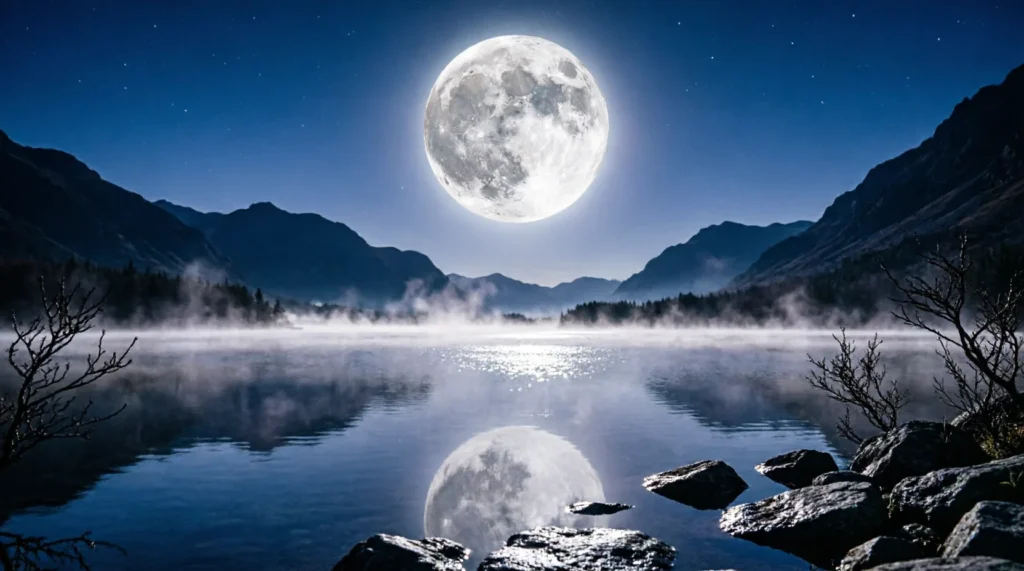
Similes for the moon help us capture its elusive glow in language that resonates with readers. The examples below are organized by mood and intensity, each demonstrated in a real sentence so you can adapt them immediately for poetry, prose, or personal writing.
Radiant and Brilliant: When the Moon Dominates the Sky
These similes work when the moon is full, high, and impossible to ignore—the kind of night where shadows stretch sharp and clear.
-
“as bright as a spotlight” — “The full moon hung as bright as a spotlight, turning the backyard into a stage.” (dramatic, theatrical)
-
“as bright as polished silver” — “She looked up at the moon, as bright as polished silver against the velvet dark.” (elegant, refined) This one has excellent alliteration with the “s” sounds, and “polished” suggests intentionality—the moon isn’t just bright, it’s been perfected.
-
“as bright as a lighthouse beam” — “The moon cut through the fog as bright as a lighthouse beam, guiding them home.” (hopeful, directional)
-
“as bright as a diamond in the dark” — “That winter moon was as bright as a diamond in the dark, sharp and unforgettable.” (precious, striking)
-
“as bright as noon daylight” — “I couldn’t sleep; the moon was as bright as noon daylight streaming through my curtains.” (overwhelming, intrusive)
-
“as bright as a camera flash” — “The moon appeared from behind the cloud as bright as a camera flash, startling and brief.” (sudden, jarring) I tell my students this simile works brilliantly for moments of revelation or shock—the unexpected brightness that changes everything.
-
“as bright as a supernova” — “In her memory, that night’s moon was as bright as a supernova, burning itself into her mind forever.” (intense, cosmic)
-
“as bright as a searchlight” — “The moon swept across the waves as bright as a searchlight, revealing everything.” (exposing, relentless)
Soft and Silvery: Gentle Moonlight for Quiet Moments
Not all moonlight is blinding. Sometimes it’s delicate, whisper-quiet, the kind that invites reflection rather than action.
-
“as bright as a nightlight” — “The crescent moon glowed as bright as a nightlight, just enough to keep the darkness at bay.” (comforting, childlike)
-
“as bright as candle flame” — “The moon shone through the window as bright as candle flame, warm and flickering.” (intimate, nostalgic)
-
“as bright as pearl dust” — “Her skin caught the moonlight, as bright as pearl dust on dark water.” (ethereal, delicate) This is the version my students always reach for first when writing romantic scenes—it suggests value without being flashy.
-
“as bright as frost on glass” — “Morning approached, but the moon remained as bright as frost on glass, crystalline and cold.” (crisp, wintry)
-
“as bright as a glow worm” — “In the forest canopy, the moon peeked through as bright as a glow worm, barely there but magical.” (whimsical, subtle)
-
“as bright as mother-of-pearl” — “The bay reflected the moon as bright as mother-of-pearl, shifting and iridescent.” (luxurious, organic)
-
“as bright as a whisper” — “The moon was as bright as a whisper, visible only if you knew where to look.” (quiet, secretive)
-
“as bright as old lace” — “The moon filtered through the curtains as bright as old lace, patterned and fragile.” (vintage, tender)
Cold and Distant: When Moonlight Feels Alien
Moonlight isn’t always welcoming. Sometimes it’s sterile, remote, the kind of brightness that emphasizes isolation rather than connection.
-
“as bright as hospital fluorescent” — “The moon through the blinds was as bright as hospital fluorescent, clinical and unwelcoming.” (sterile, uncomfortable)
-
“as bright as a skull” — “The full moon hung in the sky as bright as a skull, bone-white and unsettling.” (ominous, gothic)
-
“as bright as ice” — “The winter moon was as bright as ice, beautiful but capable of cutting you.” (dangerous, sharp)
-
“as bright as a ghost” — “She saw the moon as bright as a ghost, present but untouchable.” (haunting, melancholic)
-
“as bright as bleach” — “The moon washed out the landscape as bright as bleach, erasing color and detail.” (harsh, destructive)
-
“as bright as a warning” — “That moon was as bright as a warning, impossible to ignore, demanding attention.” (urgent, alarming)
-
“as bright as a dead star” — “The moon shone as bright as a dead star, light from something already gone.” (existential, mournful) I use this one when discussing how similes can carry thematic weight—this isn’t just about brightness, it’s about absence and memory.
-
“as bright as a mirror in space” — “The moon reflected sunlight as bright as a mirror in space, cold and indifferent.” (scientific, detached)
Poetic and Mythic: Elevated Language for Literary Work
When you’re writing something that needs to transcend the ordinary, these similes reach for the archetypal and the timeless.
-
“as bright as Diana’s bow” — “The moon arced across the sky as bright as Diana’s bow, divine and untouchable.” (classical, majestic)
-
“as bright as a fallen star” — “The moon rested on the horizon as bright as a fallen star, celestial but grounded.” (romantic, wistful)
-
“as bright as angel wings” — “In his prayer, the moon seemed as bright as angel wings, pure and protective.” (spiritual, reverent)
-
“as bright as a promise” — “The harvest moon rose as bright as a promise, full of potential and hope.” (optimistic, forward-looking)
-
“as bright as eternity” — “She imagined the moon as bright as eternity, unchanging while everything else decayed.” (philosophical, timeless)
-
“as bright as a siren’s song” — “The moon called to him as bright as a siren’s song, beautiful and dangerous.” (seductive, perilous)
-
“as bright as destiny” — “That night, the moon was as bright as destiny, inevitable and inescapable.” (fateful, powerful)
-
“as bright as a prayer” — “The moon glowed as bright as a prayer, hopeful and fragile.” (devout, vulnerable) This simile works because it transforms light into intention—brightness becomes an act of faith rather than just physics.
Everyday and Accessible: Similes That Feel Natural
Sometimes the best similes are the ones that don’t call attention to themselves. These work in casual writing, dialogue, or when you want clarity over ornament.
-
“as bright as a streetlamp” — “The moon was as bright as a streetlamp, reliable and familiar.” (practical, urban)
-
“as bright as a phone screen” — “He checked his watch; the moon was as bright as a phone screen in the dark.” (contemporary, relatable)
-
“as bright as a flashlight” — “She walked with the moon as bright as a flashlight, lighting her path.” (functional, straightforward)
-
“as bright as a white sheet” — “The moon made the snow as bright as a white sheet, blinding in its uniformity.” (simple, visual)
-
“as bright as a lamp” — “The moon through the trees was as bright as a lamp, steady and reassuring.” (domestic, warm)
-
“as bright as paper” — “The moon reflected off the lake as bright as paper, flat and two-dimensional.” (minimal, clean)
-
“as bright as a clock face” — “At midnight, the moon was as bright as a clock face, marking time in the sky.” (temporal, precise)
How to Write Your Own Moon Simile
Creating original moon similes is about matching the moon’s quality to something unexpected but recognizable. Here’s my three-step process:
Step 1: Identify the specific quality of moonlight you’re describing. Is it harsh or soft? Cold or warm? Constant or changing? Be precise—”bright” alone is too vague.
Step 2: Brainstorm objects or phenomena that share that quality but belong to a different category. If the moonlight is “harsh,” think of harsh things: alarms, fluorescent lights, winter wind. The further the comparison is from typical moon imagery, the more memorable it becomes.
Step 3: Test it aloud. A good simile has rhythm. “As bright as a bone” has punch; “as bright as something that is very bright” does not.
Worked example: Let’s say you’re writing about moonlight on water, and it’s shimmering, unstable, beautiful but impossible to hold. You might land on: “The moon on the lake was as bright as a secret someone’s trying to keep”—it captures that elusive, flickering quality while adding emotional weight.
Frequently Asked Questions
What makes a moon simile effective?
The best moon similes create an instant visual while also suggesting mood or theme. “As bright as a spotlight” tells you about intensity and drama; “as bright as a whisper” tells you about subtlety and intimacy. Effectiveness comes from specificity and emotional resonance, not just visual accuracy.
Should I avoid clichéd moon similes?
Yes. Comparisons like “as bright as the sun” (the moon is never that bright) or “as bright as day” (too vague) are tired and imprecise. Your readers have encountered them hundreds of times. Instead of “as bright as a diamond,” try “as bright as a diamond cutter’s laser”—same brilliance, more original. For more on avoiding clichés in figurative language, see Purdue OWL’s guide on figurative language.
Can moon similes work in different genres?
Absolutely. A horror story might use “as bright as a skull” to create unease, while a romance might use “as bright as a promise” to suggest hope. The moon is versatile—it can be romantic, threatening, mysterious, or mundane depending on your comparison. Choose similes that reinforce your genre’s emotional tone.
How do I know if my moon simile is too complicated?
Read it aloud once. If you stumble, or if the comparison requires more than a second to understand, simplify it. “As bright as a supernova” is instantly graspable; “as bright as the theoretical maximum luminosity of a Type Ia supernova” is not. Similes should illuminate, not obscure. The Merriam-Webster definition of simile emphasizes that similes are meant to clarify through comparison—if yours doesn’t, revise it. For more on this figure of speech, see Wikipedia’s overview of similes.

Melissa Harris combines her background in creative writing with a keen analytical mind to bring a unique perspective on similes and figurative language. She holds a Bachelor of Arts in Creative Writing from the University of Iowa and a Ph.D. in Comparative Literature from Stanford University. Her love for the lyrical and the whimsical aspects of language drew her to specialize in figurative speeches, such as similes. With over a decade of experience as a writer and editor, Melissa is adept at breaking down complex figurative constructs into digestible insights for her audience. She is especially interested in the cognitive impact of similes in poetry and prose and enjoys experimenting with innovative approaches to simile creation in her writing. At SimileStation, Melissa contributes in-depth analysis pieces and creative exercises designed to spark imagination and refine readers’ use of similes. Her work inspires others to view language as an ever-evolving canvas, where words create a vivid tapestry of expression.